Jan Chodkiewicz
 Ukraine
Jan Karol Chodkiewicz: A Biography
Jan Karol Chodkiewicz was a military and political leader of the Polish-Lithuanian Commonwealth. He was born into a noble Lithuanian family and became the Grand Hetman of Lithuania in 1605. Chodkiewicz was descended from Borayka, a boyar in the court of Lithuanian Prince Vytautas, as evidenced by a royal charter granting him the title of Count. He was the son of Jan Hieronim Chodkiewicz, the castellan of Vilnius, and Krystyna Zborowska.
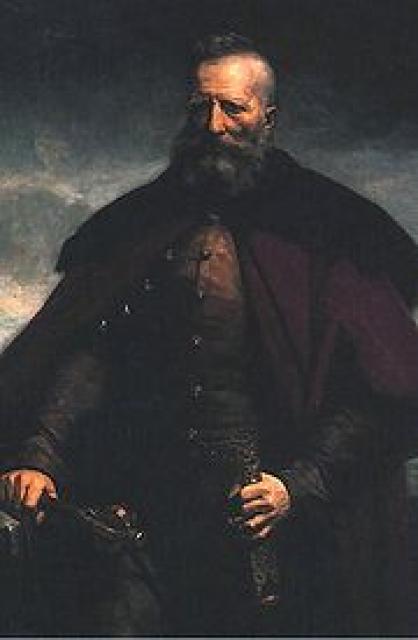
Chodkiewicz studied at the University of Vilnius before traveling abroad. From 1586 to 1589, he studied philosophy and law at the Jesuit Academy in Ingolstadt, Bavaria, with his brother Aleksander. He then traveled to Italy and Malta to study military arts and served in the Spanish army in the Netherlands, where he met Duke Alba and Maurice of Nassau. Chodkiewicz began his service in the Polish-Lithuanian forces under Hetman Zolkiewski during the suppression of the Nalyvaiko Uprising. He also participated in campaigns in Moldavia under the command of Jan Zamoyski. In 1601, he became the Field Hetman of the Grand Duchy of Lithuania and actively participated in the war against Sweden. Despite the difficulties, including the lack of assistance from King Sigismund III and the Sejm, Chodkiewicz achieved victories. In 1604, he captured Dorpat (now Tartu, Estonia) and defeated the Swedish forces twice. In March 1605, he was rewarded with the title of Grand Hetman of the Grand Duchy of Lithuania for his victories. However, his greatest victory was yet to come.
In September 1605, Swedish forces were concentrated near Riga, with another army led by King Charles IX also heading there. This gave the Swedes a clear advantage over the forces of the Polish-Lithuanian Commonwealth. On September 27, 1605, the Battle of Kircholm (now Salaspils, Latvia) took place. Chodkiewicz had around 4,000 soldiers, mostly heavy cavalry (hussars). The Swedish army numbered about 11,000 soldiers, the majority of whom were infantry. Despite the unfavorable balance of forces, Chodkiewicz managed to defeat the Swedish army within three hours. The key to his victory was the skillful use of cavalry: by luring the enemy away from their fortified positions with a feigned retreat, Chodkiewicz's forces crushed the advancing Swedish infantry and, with the support of artillery, routed the main enemy forces. King Charles IX was forced to flee the battlefield, and the Swedish army, having lifted the siege of Riga, returned to Sweden. Chodkiewicz received congratulatory letters from Pope Paul V, Catholic monarchs of Europe (Rudolf II of Austria and James I of England), as well as from the Ottoman Sultan Ahmed I and Persian Shah Abbas.
However, even such a significant victory did not improve Chodkiewicz's military position financially. The treasury was still empty, and the army began to disperse. Internal unrest led to the so-called "rokosz" uprising against King Sigismund III's attempts to centralize the government. Among the Polish nobility, one of the leaders of the rebellion was Jan Radziwill, a Calvinist. Chodkiewicz initially remained neutral in the conflict, but after Jan Radziwill joined the rebels against him, he condemned the uprising and supported the king. On July 6, 1607, in the Battle of Guzow, the royal army defeated the opposition, with Chodkiewicz commanding the right flank.
However, the victory over the opposition and the suppression of their uprisings did not allow the king to continue his reforms of governance. A compromise was reached that effectively ended the centralizing policies of King Sigismund. Meanwhile, Swedish forces became active again. Internal unrest in the Polish-Lithuanian Commonwealth allowed them to capture Beliy Kamien in 1607 and Dünaburg (now Daugavgriva) on August 1, 1608. In October 1608, Chodkiewicz returned to Inflanty and immediately went on the counteroffensive. On March 1, 1609, his 2,000-strong army took Parnu by a night assault and then returned to Riga. Chodkiewicz's troops achieved success once again: his cavalry units defeated the advancing Swedish forces, forcing the Swedish commander, Count Mansfeld, to retreat from Riga. The capture of the fortress Dünaburg and the victory of the small Polish-Lithuanian fleet over the superior Swedish fleet secured an advantage for the Polish-Lithuanian Commonwealth in the region. However, Chodkiewicz did not receive any reinforcements as King Sigismund was preparing for war with Russia. The death of Swedish King Charles IX on October 30, 1611, allowed for peace negotiations, and military actions in the Baltic were halted until 1617. The reason for starting the war with the Moscow State was the introduction of a Swedish corps led by Jacob De la Gardie into Russian territory at the request of Tsar Vasily Shuisky. As the Polish-Lithuanian Commonwealth was at war with Sweden, this was seen as a hostile act. King Sigismund personally led the troops invading Russian territory. In September 1609, he began the siege of Smolensk, which ended with the fall of the city in June 1611. After the humiliating defeat of the Moscow army under the command of Dmitry Shuisky (the brother of the Tsar) by the forces of Hetman Stanislaw Zolkiewski near Klushino on July 24, 1610, Tsar Vasily Shuisky was overthrown. The new government, known as the "Seven Boyars," invited Prince Vladislav to the Moscow throne, but Sigismund did not allow his 15-year-old son to go to Russia. Moscow was occupied by the Polish-Lithuanian garrison with Stanislaw Zolkiewski as the leader.
As the Grand Hetman of Lithuania, Jan Karol Chodkiewicz opposed supporting False Dmitry II and going to war with Russia. Based on his experience of fighting against Sweden, where the lack of money and reinforcements prevented him from inflicting a decisive blow on the enemy, there was no hope for a quick victory. Nevertheless, in April 1611, Chodkiewicz launched an attack on Pskov and besieged the Pskovo-Pechersky Monastery for five weeks, but he failed to capture it and had to retreat. In early autumn 1611, Jan Karol Chodkiewicz, on the king's orders, led an army to assist the Polish-Lithuanian garrison in the Moscow Kremlin. Supplies and ammunition were gathered in Shklov, and on October 6, 1611, his 2,000 soldiers approached Moscow. Chodkiewicz's troops had to withstand several clashes with the 1st Militia under the command of Dmitry Trubetskoy, which saved the Polish-Lithuanian garrison in the Kremlin from surrender, but they failed to deliver supplies to the besieged. Discord arose within Chodkiewicz's army between the Poles and soldiers from the Grand Duchy of Lithuania, and in early November 1611, the army, reduced to 2,000 soldiers, retreated to Rogachevo. Here, Chodkiewicz gathered supplies again and finally delivered them to the garrison in the Kremlin on December 18.
In 1612, similar expeditions to supply the Polish-Lithuanian garrison in the Kremlin were successful twice more. The next campaign took place in late August to early September 1612. At the same time, King Sigismund and Prince Vladislav headed towards Moscow to claim the Russian throne. However, the armies were delayed near Volokolamsk and did not prevent the capitulation of the Polish-Lithuanian garrison in the Kremlin.
In February 1613, the Zemsky Sobor elected Mikhail Romanov to the Russian throne, making the hopes of the Polish-Lithuanian Commonwealth and King Sigismund for the Russian crown even more elusive. From 1613 to 1615, Chodkiewicz commanded the Polish-Lithuanian forces in the newly formed Smolensk Voivodeship. During this time, the royal court returned to the plan of placing Prince Vladislav on the Moscow throne. Chodkiewicz led the Polish-Lithuanian forces.
On October 11, 1617, Chodkiewicz's forces captured the fortress of Dorogobuzh and later besieged and captured Vyazma. From Vyazma, Vladislav began sending letters to various segments of the Russian population. However, these letters had little success, as most of the nobles, gentry, and Cossacks remained indifferent to them. After the capture of Vyazma, the harsh winter weather halted military operations. Prince Vladislav and Chodkiewicz remained in Vyazma, preparing for further campaigns. The military actions were reduced to raids on the war-ravaged surrounding areas by the light cavalry units led by Aleksander Lisowski, known as the "Lisowczycy." In the spring of 1618, forces were gathered for an advance on Moscow. Chodkiewicz commanded 14,000 soldiers, including about 5,500 infantry. However, discipline in the army was weak, and there were disagreements over command positions. Decisions were often influenced by Prince Vladislav and his favorites. The situation worsened when news arrived that the Sejm had only sanctioned funding for the campaign against Russia for 1618.
In June 1618, Chodkiewicz's forces began the campaign towards Moscow. Chodkiewicz himself wanted to advance through Kaluga, but Vladislav insisted on a direct attack on the Russian capital. In early October 1618, the Polish-Lithuanian forces occupied the village of Tushino (north of Moscow) and began preparations for a siege. Simultaneously, a 20,000-strong Cossack army under hetman Petro Sahaidachny approached Moscow from the south. On the night of October 10, the Polish-Lithuanian forces launched a siege of Moscow, attempting to break through the Tverskaya and Arbat Gates, but the assault was repelled. In the face of approaching winter and lack of funding, Prince Vladislav agreed to negotiations. On December 11, 1618, a truce was signed in the village of Deulino (near the Trinity Lavra of St. Sergius) for a period of 14 and a half years. According to the terms of the truce, Russia ceded the Smolensk land, which became part of the Grand Duchy of Lithuania, as well as Chernigov and Seversk lands, which became part of the Polish Crown.
Jan Karol Chodkiewicz returned from this campaign disillusioned. Years of constant wars had taken a toll on his health, and he fell ill more frequently. Not everything was well in his family either. Chodkiewicz temporarily withdrew from state affairs and focused on managing his estates. In 1620, the Polish-Lithuanian Commonwealth was dragged into a war with the Ottoman Empire. In August 1620, the Polish army suffered a crushing defeat at Cecora (near Jassy). Grand Hetman Stanislaw Zolkiewski was killed, and Field Hetman Stanislaw Koniecpolski was captured. In December 1620, Jan Karol Chodkiewicz took command of all the forces of the Polish-Lithuanian Commonwealth.
In September 1621, Chodkiewicz crossed the Dniester, captured the fortress of Hotin, and repelled all attacks by the significantly superior Turkish forces and their vassal, the Crimean Khanate. On September 23, Chodkiewicz, severely ill, handed over command of the army to Crown Grand Marshal Stanislaw Lubomirski. Jan Karol Chodkiewicz, the Grand Hetman of Lithuania, died on September 24. Learning of his death, the Turks attempted to capture the Polish-Lithuanian army's camp again but were twice unsuccessful. Suffering heavy losses, the Ottoman Empire was forced to make peace with the Polish-Lithuanian Commonwealth, and the treaty was signed on October 9, 1621. Chodkiewicz won his final battle as the war with the Turks came to an end. Jan Karol Chodkiewicz married Sofia Melecka (1567-1619), the daughter of Podolian Voivode and Crown Grand Hetman Mikolaj Melecki and the widow of Jan Szymon Olizarowicz, the Sluck prince, in 1593. They had a son, Hieronim (1598-1613), and a daughter, Anna-Scholastika (1604-1625), who married Jan Stanislaw Sapieha (1589-1635), the eldest son of Lew Sapieha, the Grand Lithuanian Chancellor. After his wife's death, Jan Karol Chodkiewicz married Anna Alojzia Ostrorzyska (1600-1654). The marriage was politically motivated, as it was encouraged by Chodkiewicz's brother, Aleksander, who did not want the family's vast possessions to pass into the hands of the Sapieha family. The marriage took place on November 28, 1620, in Yaroslavl. Immediately after the wedding, the hetman went to the Sejm in Warsaw and then embarked on his final campaign.
After Jan Karol Chodkiewicz's death, significant estates were left behind. The main ones included Bykhov and Gory in the Orsha powiat, Lyakhovichi in the Novogrudok powiat, Svisloch in the Volkovysk powiat, Shkudy and Krettinga in the Samogitia region. Together with his brother, Aleksander, he owned Shklov and the Shklov County. It is worth noting that due to the lack of state funding, Jan Karol Chodkiewicz used his personal funds to support the army, resulting in debts amounting to 100,000 zlotys (more than the annual income from all his possessions) at the time of his death. However, disputes over Chodkiewicz's property arose between noble families who were also related to him. Claims were made by his daughter, Anna-Scholastika, and her husband, Stanislaw Sapieha, his brother, Aleksander Chodkiewicz, and finally, his young widow, Anna Alojzia Chodkiewicz (nee Ostrorzyska), with her guardians.
The struggle for the property ended only two years later, in May 1623, when all the relatives finally divided the hetman's inheritance. The widow of the hetman succeeded in having his body buried not in Kretyng, which belonged to the Chodkiewicz family (where his first wife was buried), as he wished, but in the residence of the Ostrorzyski princes - the town of Ostrog in Volhynia.