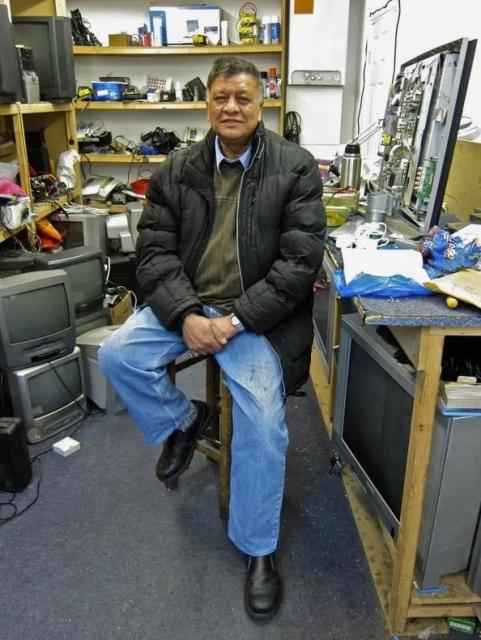
Javed Iqbal
 Great Britain
- An Unwelcoming London
- Struggles in Secondary School
- Skinheads and Police Brutality
- A Lifeline to Television Repair
- Perseverance and Triumph
- The Promise of Spitalfields
An Unwelcoming London
In 1960, Pakistani television repairer Javed Iqbal immigrated to London's Brick Lane with his father. As a seven-year-old, his first day at a Christian school where he was the only Asian student ended with a broken arm. Derogatory terms like "dogs" were hurled at Asians, Irish, Jews, and Blacks.
Struggles in Secondary School
Upon transitioning to secondary school on Deal Street, Iqbal faced further adversity. The cafeteria was segregated, with Christians receiving non-kosher meals and Jews receiving kosher meals. As there were no halal options, he joined the Jewish students for meals. Iqbal formed a friendship with an Indian girl named Janel Singh, and they often faced beatings from white children.
Skinheads and Police Brutality
After completing school, Iqbal worked as a cleaner in the Royal London Hospital and repaired televisions in a shop owned by a Mauritian man. One evening, skinheads brutally attacked him on his way home from work, leaving him unconscious. Despite calling a taxi, the driver refused to take him to the hospital due to his blood-covered appearance.
A Lifeline to Television Repair
With a recommendation from his father's friend, Dr. Woolfitt, Iqbal sought employment as a television repairer. However, he was met with rejection in Dagenham, where he was told he'd be stabbed rather than allowed to repair televisions. He briefly worked in Rotherhithe, where Asian laborers faced resistance from dockworkers.
Perseverance and Triumph
Finally, Iqbal found work at Derwent Television in Streatham, earning £16 per week. A customer later offered him a position at Visionhire, where he earned £50 per week. In 1976, he opened his own shop on Heneage Street in Spitalfields, the same neighborhood where he had visited as a child with his father.
The Promise of Spitalfields
Despite the challenges faced by his fellow Bengalis in the area, Iqbal vowed to make a positive contribution to the diverse community. And for the next 38 years, he remained true to his promise. He attributes his resilience and entrepreneurial success to the grace of God.