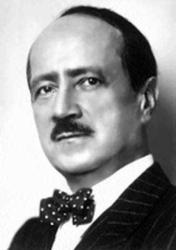
Jean Cocteau
 France
Biography of Jean Cocteau
Jean Cocteau (5 July 1889 - 19 October 1963) was a French avant-garde writer, film director, actor, and artist. He was a master of illusions, deception, and surprises, both in his art and in his life. Cocteau's career cannot be defined by one or even three words. He was a poet, known for his exquisite verses, and was honored with the unique title of "Prince of Poets" by the French Academy.
In addition to his poetry, Cocteau also published books of drawings, created posters and set designs for plays, and even painted several churches in the outskirts of Paris, in Villefranche-sur-Mer, and even in London. He also wrote plays, often accompanied by scandals and always attracting the best actors, such as Charles Dullin, Yvonne de Bray, Jeanne Moreau, Edwige Feuillère, and Jean Marais. His plays, such as "Sacred Monsters," "Terrible Parents," "The Two-Headed Eagle," and "Human Voice," gained international recognition and are still famous in Russia.
In addition to his work as a writer and artist, Cocteau also ventured into the world of cinema. He wrote screenplays for films such as "Eternal Return," "Terrible Children," and "Ruy Blas." He also directed films based on his own scripts, including "Blood of a Poet," "Orpheus," and "Testament of Orpheus." Cocteau also appeared as an actor in various films.
Cocteau's journey into the world of art and avant-garde began when he met Sergei Diaghilev, the famous impresario of the Ballets Russes. Diaghilev challenged Cocteau to "amaze him," and Cocteau did just that. Cocteau often said that Diaghilev made him "die" in order to be born as the true Jean Cocteau - a poet. This transformation occurred in the 1910s, during the time of Diaghilev's Russian Seasons, which captivated the entire city of Paris. Cocteau's impact was not limited to young impressionable individuals, but also influenced established and knowledgeable connoisseurs such as Auguste Rodin, Marcel Proust, the renowned portraitist Jacques-Emile Blanche, and Coco Chanel.
Cocteau's collaboration with Diaghilev led him to create posters featuring portraits of Vaslav Nijinsky and Tamara Karsavina. He initially composed a rather ordinary libretto for the ballet "The Blue God," but later conceived the extraordinary "Parade" and "The Blue Train." "Parade" was a daring creation for its time. The ballet had no plot and the performers showcased fragments of their acts in front of a painted backdrop, while the audience remained unaware of what was happening behind the scenes. The music was an arrangement of street melodies, and the performance was accompanied by various sounds such as typewriter clicks and engine roars. Cocteau himself devised most of the movements resembling dance, and Pablo Picasso created the costumes and set designs.
Despite the initial controversy and criticism, "Parade" found great success in 1920 when it was warmly received by the Parisian audience. Diaghilev decided to keep it in the repertoire permanently. It seems that it was Diaghilev's enterprise that showed Cocteau how art could transcend any boundaries - be it style, genre, or direction. Diaghilev was not afraid of any experiment as long as it showcased talent. His art knew no caste rules and did not conform to any "ism." Diaghilev fearlessly juxtaposed romantic and cubist, surrealist and abstract ballets, much to the chagrin of the ideologues of the time. Cocteau would experience a similar fate. He would be labeled as a magician and a trickster after he had just convinced the world of his avant-garde nature with "Parade" and the farce "The Bull on the Roof." However, his pantomime "The Newlyweds on the Eiffel Tower," accompanied by text and music, parodied not only the avant-garde but also his fellow citizens and even himself as a faithful "ideologue." Later on, Cocteau would gravitate towards biblical and classical themes, contemplating projects such as "David" set to Stravinsky's music. In 1922, he staged "Antigone," followed by "Oedipus" in 1923 (where he also played a role), and much later, "Terrible Parents," a play beloved by audiences.
Cocteau was known for his ability to amaze, deceive, and surprise. He effortlessly moved between different art forms and addressed "forbidden topics" without hesitation. His works contained frank and unconventional depictions of eroticism, the lives of pimps, prostitutes, and street youth, as well as references to opium and cocaine, which he seamlessly incorporated into his most profound and moving texts. Cocteau's seeming ease and inconsistency led many to believe that he was a child at play. This made it easy to explain how he effortlessly overcame any boundaries without visible effort or struggle. His disregard for conventions was never accompanied by contempt, and his audacity was delivered with subtlety.
Throughout his life, Cocteau attracted the care and protection of many. Strong, determined, and vibrant women were always by his side, such as Misia Sert, Coco Chanel, Edith Piaf, and Francine Weisweiller. He welcomed their protection. In one of her letters, Edith Piaf expressed her desire to protect him from the cruelties of the world and how, after each encounter, she felt that Jean helped her navigate through life. He was both a lover and a friend to Raymond Radiguet, Jean Debord, and Jean Marais, supporting each of them in their own journeys.
Cocteau's generous love and bold friendship were extended to those who were vulnerable and in danger. When writer Jean Genet was on trial for theft, Cocteau defended him in court. He also campaigned for the release of Max Jacob, a poet and priest who was arrested by the Gestapo. Cocteau came close to securing his release, but unfortunately, the order came too late, and Jacob passed away in prison. Cocteau was not afraid of pain or death, even when he knew it was at his doorstep. In his film "Orpheus," he personified Death as his former lover, Natalie Paley, and declared that the dead are never far away - that we are separated from them by the thinnest of veils, just like two sides of the same coin. Cocteau was an artist who, in a strange way, was free from envy or resentment towards the success of others, and instead, he encouraged creativity in everyone around him.
Jean Cocteau depicted numerous stars and often used a star as a signature. His art was both profound and playful. His life was filled with love, friendship, and artistic exploration. Jean Cocteau's legacy continues to resonate through his poetry, prose, plays, and films, which have left an indelible mark on the world of art and culture.