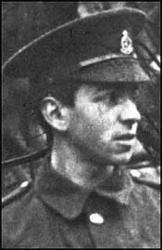
Jean Dubuffet
 France
- Jean Dubuffet: Pioneer of Art Brut and Spontaneous Drawing
- Artistic Breakthrough
- Rise to Fame
- Spontaneous Drawing Technique
- Monumental and Architectural Work
- Legacy
Jean Dubuffet: Pioneer of Art Brut and Spontaneous Drawing
Early Life and CareerJean Dubuffet, born in Le Havre, France on July 31, 1901, initially pursued painting in 1916 before exploring other artistic endeavors, including literature and music. After holding various jobs, he established a wine shop in Paris in 1940.
Artistic Breakthrough
In 1942, Dubuffet dedicated himself to art, creating "naive" sketches reminiscent of childhood art. His first exhibition took place in 1944 at the Galerie René Drouin in Paris. From 1946, he developed the "hautes pates" technique, using a "raised paste" of plaster, lime, and cement instead of traditional paints. The resulting textured surfaces featured line-scratches, creating abstracted "portraits," "landscapes," and "scenes" characterized by their chaotic and muted quality.
Rise to Fame
Dubuffet's scandalous "Women's Bodies" series (1950) depicted nude figures as if flattened by a steamroller. Simultaneously, he wrote theoretical essays, emphasizing the need for "brut" (raw) art to expose the subconscious without the conventions of surrealism. Through exhibitions and publications, he established a historical-ethnographic foundation for his neo-primitivism, which embraced children's art, "primitive" cultures, and the work of the mentally ill.
Spontaneous Drawing Technique
In the 1960s, Dubuffet became captivated by spontaneous-unconscious drawing using ballpoint pens, coining the untranslatable term "hourloupe" for these works. These intricate yet chromatically sparse graphic works became a defining aspect of his later career.
Monumental and Architectural Work
Dubuffet's practice extended to monumental-decorative and architectural endeavors. Most notably, he designed his own "Villa Falbala" (1971–1973) in Périgny, near Paris, constructed entirely of plastic.
Legacy
Dubuffet's art gained international recognition and was exhibited at the Solomon R. Guggenheim Museum in New York in 1973. Through collaborations with the musical theater "Coucou Bazar," he presented his art in a staged performance. Dubuffet passed away in Paris on May 12, 1985, leaving behind a lasting legacy as a pioneer of art brut and spontaneous drawing.