Jean Goujon
 France
- Biography of Jean Goujon
- Early Life and Career
- Collaboration with Pierre Lescot
- Contributions to the Louvre
- Legacy and Disappearance
Biography of Jean Goujon
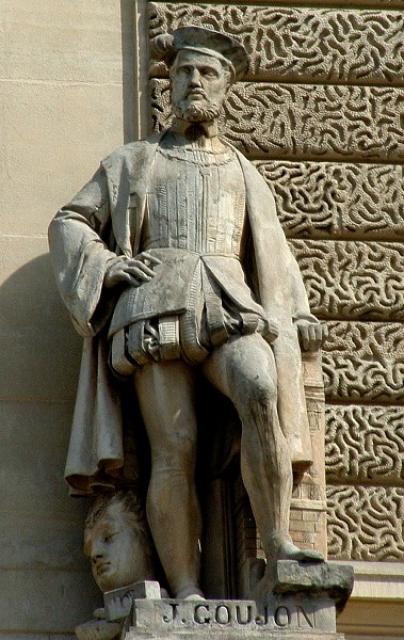
Jean Goujon was a French sculptor, architect, and graphic artist, renowned as a master of the Renaissance period. His style, characterized by purity and elegance, had a significant influence on the development of decorative arts in France. In honor of his contributions, there is a street named after him in Paris.
Early Life and Career
Precise details about Goujon's early years are scarce. It is believed that he was born in Rouen, France. The first mentions of him can be found in the city archives in 1541, where he is referred to as an architect and sculptor. It is speculated that he visited Rome and was influenced by the Italian architect Sebastiano Serlio, who arrived in France in 1541. However, unlike Italian artists who were inspired by the idea of reviving the grandeur of Ancient Rome, Goujon embodied the spirit of ancient Greek art in his works.
Goujon worked on the Chapel of Saint-Romain and the tomb of the great Seneschal of Normandy, Louis de Brézé, in Rouen Cathedral. He also gained great success in Paris, where he was hailed by Ronsard as the greatest sculptor of the era. His work in the Church of Saint-Germain l'Auxerrois in 1544, where he executed the relief of the Lamentation of Christ and four reliefs depicting the evangelists (now housed in the Louvre), is documented.
Collaboration with Pierre Lescot
Goujon's most significant works emerged from his creative partnership with the architect Pierre Lescot. Together, they participated in the festive decoration of Paris to commemorate the grand entrance of King Henry II into the city in 1549. One of their notable creations was the "Fountain of the Innocents," considered one of the most famous works of French Renaissance. Goujon sculpted 12 reliefs for the fountain, featuring horizontal reliefs with cherubs, naiads, and tritons, as well as vertical reliefs depicting nymphs. The fountain derived its name from the nearby church and perfectly suited the nymph figures created by the artist. Notably, Goujon introduced a new type of bas-relief, with figures fully contained within frames, creating an illusion of perspective on a flat stone slab.
The existing fountain, reconstructed in 1787 and relocated to the center of the Marché des Innocents, incorporates Goujon's reliefs depicting nymphs and other decorative motifs. However, additional reliefs by sculptor Augustin Pajou were added due to architectural changes. Since the early 19th century, the original sculptures from the "Fountain of the Innocents" have been housed in the Louvre, while copies have been installed at the fountain site.
Contributions to the Louvre
One of Goujon's significant collaborations with Lescot was their involvement in the construction of the new Louvre building from 1548 to 1562. Goujon played a role not only as a sculptor but also contributed to the architectural design. He created the sculptural decoration for the courtyard facade in the late 1540s and 1550s. For the Caryatid Hall in the Louvre, Goujon executed female figures (1550) supporting the lectern. Lescot and Goujon bestowed upon the Louvre its enduring appearance, which, despite subsequent alterations, has survived to the present day.
It is believed that Goujon was also responsible for the sculptural embellishments of Hôtel de Ligneris (now Carnavalet Museum, circa 1545) and the Château d'Écouen for Connétable Anne de Montmorency.
Legacy and Disappearance
Goujon was also recognized as a graphic artist, producing engravings illustrating Vitruvius' treatise on architecture. After 1562, his name disappears from the royal accounts. It is believed that, as a Protestant, he was forced to leave France due to the persecution of Protestants. There is no exact information about Goujon's time and place of death. Researchers speculate that he died in exile between 1563 and 1568, possibly in Bologna.
In 1871, during a fire, Goujon's Allegories of the Twelve Months from the Paris City Hall, created in the 1540s and 1550s, were lost.