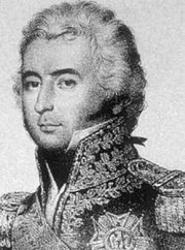
Jeanno Monsey
 France
- Childhood and Early Military Career
- Revolutionary Wars
- Napoleon's Service
- Peninsular War and Defense of Paris
- Restoration and Later Life
Childhood and Early Military Career
Jeannot de Moncey, later known as the Duke of Conegliano, was born on July 31, 1754, in Palyz, France. The son of a lawyer, he initially pursued a legal education before abandoning it to join the Condé Regiment in 1769. However, his father managed to buy him out of the service. Undeterred, Moncey reenlisted in the Champagne Infantry Regiment in 1769, only to be recalled home again by his father. In 1774, he joined the gendarmerie as a private.
Revolutionary Wars
In August 1779, Moncey was promoted to sub-lieutenant in the Nassau-Siegen Infantry Corps. During the French Revolution, he rose through the ranks, becoming a battalion commander in 1793. He fought in the Pyrenees from 1793 to 1795, earning promotions to brigadier general (1794) and divisional general (1794). In 1794, he captured the fortress of San Sebastián, leading to a successful offensive in Catalonia and Basque Country.
Napoleon's Service
After being dismissed from the army for his perceived royalist sympathies, Moncey returned to military service under Napoleon in 1799. He served in Italy, where he distinguished himself at the Battle of Marengo and the crossing of the Saint Gotthard Pass. In 1801, he became general inspector of the gendarmerie, a post he held for over a decade. During Napoleon's coronation in 1804, Moncey carried the Empress Josephine's coronation mantle.
Peninsular War and Defense of Paris
From 1807 to 1808, Moncey commanded the Observation Corps of the Oceanic Coast. In 1808, he led the 3rd Corps of the Army of Spain, defeating Spanish forces at Almansa and Jaén. In 1814, he became chief of staff of the National Guard of Paris and played a crucial role in the city's defense against Allied forces. His efforts earned him the reputation as one of Napoleon's most honorable marshals.
Restoration and Later Life
After the Bourbon Restoration, Moncey was appointed a peer of France. However, he was deprived of this title for refusing to participate in the trial of Marshal Ney during the Hundred Days. He was eventually reinstated and became a peer once more in 1819. From 1820 to 1830, he served as governor of the 9th military district. He also commanded the 4th Corps of the Pyrenean Army during the Spanish Campaign in 1823. From 1833 until his death in 1842, Moncey served as governor of the Hôtel des Invalides, where he welcomed the remains of Napoleon in 1840.