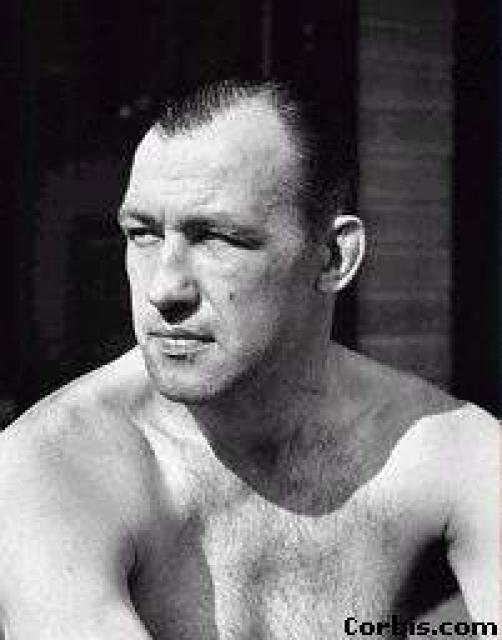
Jeck Sharki
 Germany
Biography of Jack Sharkey
Jack Sharkey (Paul Zukauskas) was born on October 26, 1902, in a family of Lithuanian immigrants. He began his independent working life at the age of 12. During World War I, he volunteered for the United States Army. He spent several years as a sailor and started boxing at the age of 16 as an amateur. He had successful performances and became the champion of the National Guard. When Gene Tunney retired, Sharkey had a chance to take his place. The American public knew him before; he was the one who, at the age of 25, fought Jack Dempsey and was knocked out after an interesting fight. It seemed that Sharkey could finally settle for his claims to the boxing throne, but things turned out differently. He weighed 96 kg and had great physical strength, but he always lacked boxing skills. Jack Sharkey served as a sailor on a military ship, where he learned to box. The fights in this environment were not much different from brawls in port taverns, so later Sharkey relied mainly on his courage and powerful, swinging punches. However, over time, gaining more experience, the former sailor somehow learned to hide his technical incompetence. Therefore, his prime started late. He achieved a series of notable victories over the British champion Phil Scott (knockout in the third round), then won against champions from different years in the light heavyweight division: Tommy Loughran and Jack Delaney, and finally defeated the outstanding heavyweight Young Stribling, who until then had been undefeated on his way to the throne.
By defeating him, Jack Sharkey became the top contender for the title match. However, another prince of boxing was needed, and there was no such contender among the Americans, which made the bosses redirect their attention to fighters from the Old World. They were confused because almost every European state brought its own candidate. Just then, unexpectedly, German Max Schmeling received the title of the European champion, and everything seemed to fall into place: the second contender was found. On June 12, 1930, the world championship was contested by 25-year-old German Max Schmeling and 28-year-old American Lithuanian Jack Sharkey. The first three rounds were clearly in Sharkey's favor, and after a successful close combat, Max's right eye was completely closed. But then the German boxer suddenly revived and stunned his opponent with several powerful blows to the head, which later allowed his supporters to explain that Schmeling, according to the plan, initially lured Sharkey to make him expose himself. In the fourth round, Sharkey was disqualified for a low blow, and Max Schmeling, knocked out by this blow, received the nickname "the horizontal champion." And to this day, it is ironic that Max Schmeling was the only absolute world champion who received this highest title in boxing while lying on the floor.
Unlucky Sharkey soon demanded a rematch - yes, he broke the rule, but accidentally, and therefore had a moral right to a second match. However, his lucky opponent was crossing the ocean on a liner at that very moment. Schmeling returned home as a national hero. His victory became a gift for fascist Germany as another evidence of the power of the Aryan race. Sharkey thirsted for Schmeling's blood and was ready to crush anyone who would stand in the way of his revenge. The last of them was Italian Primo Carnera, a 120-kilogram giant, but still inexperienced and physically unprepared for a brutal match. He stood on his feet until the end but looked like a punching bag in the final rounds. In those moments, Jack Sharkey broke his finger, but his rage was so great that he only noticed the injury in the locker room.
The American public this time thirsted for Sharkey's coronation and only his coronation. The organizers acted in the same spirit. When Joe Jacobs, Schmeling's manager, learned that the referee in the ring was Gene Tunney's longtime friend Gambot Smith, he grimly stated, "They won't let my guy win!". The fight took place on June 21, 1932. Schmeling must be given credit; he prepared well for the match. Serious experts claimed that Max clearly won eight rounds, looked weaker in six, and was on par with Sharkey in one. Nevertheless, Smith raised the former sailor's hand. The fickle crowd bid farewell to Max with admiring whistles and cheers: even the most desperate patriots felt the injustice in what had happened and their guilt towards Schmeling.
Jack Sharkey did not sit on the throne for long. On June 29, 1933, at the "Long Island" stadium in New York, a world championship match took place between Jack Sharkey and the experienced Primo Carnera. The world champion bravely resisted the giant. In the second round, Carnera took a brutal blow to the jaw. By the fifth round, he received two warnings, but in the sixth round, he woke up like Vesuvius and, rushing at Sharkey, knocked him down with two uppercuts. After this defeat, Sharkey continued to compete in the ring for a few more years until 1936 but without success. He had his final fight against the emerging star of professional boxing, Joe Louis. Sharkey was ranked among the top ten heavyweight boxers in the world for eight years, being the first three times and the world champion in 1932-1933.
Former champion Jack Sharkey passed away at the age of almost 92 on August 17, 1994.