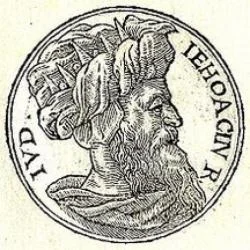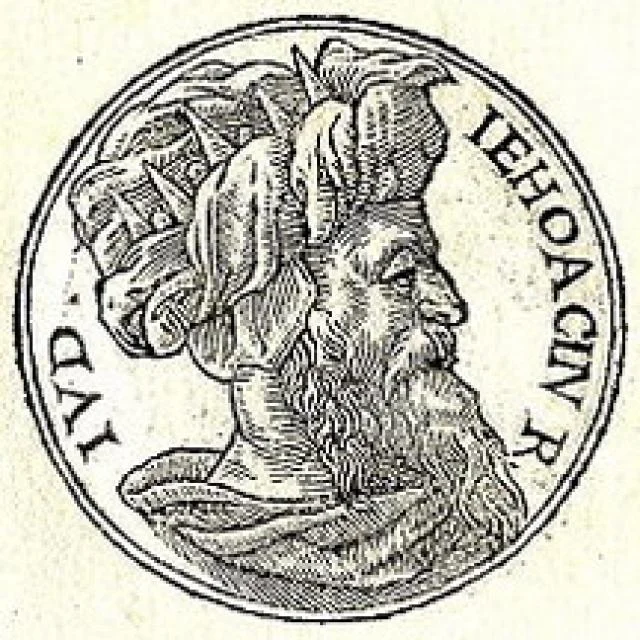
Jeconiah
Jeconiah, also called Jehoiachin and Coniah, was one of the last kings of Judah before the Babylonian exile. His reign lasted only a few months, ending when Nebuchadnezzar II captured Jerusalem in 597 BCE. Carried away to Babylon with members of the royal household and Jerusalem’s elite, he remained a symbol of Judah’s lost monarchy. Decades later, a Babylonian king released him from confinement and restored him to a place of honor.
A Brief Reign in Jerusalem
Jeconiah was the son of King Jehoiakim and grandson of Josiah. He came to the throne as Babylonian power pressed hard against Judah. The biblical books of Kings and Chronicles describe him as a young ruler; Kings gives his age as eighteen, while Chronicles preserves a different reading of eight. Both accounts agree that he ruled for about three months before Jerusalem surrendered.
Nebuchadnezzar’s forces besieged the city, and Jeconiah went out to meet the Babylonian king with his mother, Nehushta, his officials and members of the court. The surrender ended his rule. Nebuchadnezzar took him captive and deported the royal family, military leaders, craftsmen and other prominent people to Babylon. Jeconiah’s uncle Mattaniah was installed as the new king and given the name Zedekiah.
The Exile in Babylon
Jeconiah’s removal was part of a larger deportation that weakened Judah by taking many of its leaders and skilled workers away. The Babylonian Chronicle records the capture of Jerusalem in 597 BCE, while the biblical accounts describe the deportation and the treasures taken from the city and temple.
Clay ration tablets from the Babylonian palace archive provide an important non-biblical reference to Jeconiah. They list provisions for “Jehoiachin, king of Judah” and members of his household, including five sons. The records show that the Babylonians continued to identify him by his royal title even after he had been deposed. They also confirm that he lived in Babylon with a royal entourage, though the ration lists alone do not establish every detail of the imprisonment described in the biblical narrative.
According to the books of Kings and Jeremiah, Jeconiah spent thirty-seven years in exile before Awil-Marduk, known in the Bible as Evil-Merodach, succeeded Nebuchadnezzar and released him. The new king treated him favorably, gave him a place at the royal table and provided him with a regular allowance. By then, Jerusalem and its temple had been destroyed, and Jeconiah’s restoration was a small but striking reversal in the story of Judah’s defeat.
Prophetic Memory and Legacy
Jeconiah appears under different names in biblical texts. Jeremiah calls him Coniah in a prophecy that rejects him as a signet ring and declares that none of his descendants would prosper on David’s throne. The language reflects the political rupture caused by his deposition and the end of his family’s immediate rule.
His descendants nevertheless remained important in later biblical tradition. The Book of Chronicles traces the royal line through his family, and the Gospel of Matthew includes Jeconiah in its genealogy of Jesus. That continuing presence, alongside Jeremiah’s severe judgment, gave him a lasting place in debates about kingship, exile and the survival of David’s line.
Jeconiah’s historical profile is brief but unusually well anchored: biblical accounts describe his surrender and release, while Babylonian administrative tablets preserve his name and the record of provisions for his household. His life began and ended as a king without a kingdom, but the archive and the scriptural tradition together kept his name in view long after Judah had fallen.