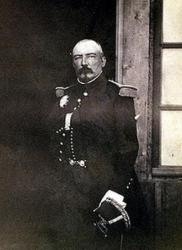
Jeffery Amherst
 Great Britain
- Early Life and Military Beginnings
- War of Austrian Succession
- Battle of Lauffeld and Return to England
- Seven Years' War
- Controversial actions
- Governor and Commander in Chief
- Military Honors and Later Career
Early Life and Military Beginnings
Geoffrey Amherst was born on January 29, 1717, in Sevenoaks, England, to a wealthy barrister. At the age of 12, he became a page in the household of the Duke of Dorset. Two years later, he enlisted in the British Army's 1st Regiment of Foot Guards.
War of Austrian Succession
Amherst fought in the War of Austrian Succession, seeing action at the battles of Dettingen (1743) and Fontenoy (1745). In 1745, he received the rank of captain in the Guards, equivalent to lieutenant colonel in the field.
Battle of Lauffeld and Return to England
In 1747, Amherst became aide-de-camp to the Duke of Cumberland and fought in the Battle of Lauffeld. After the war, he returned with his regiment to England.
Seven Years' War
During the Seven Years' War, Amherst commanded British forces in North America. He led the successful siege of Louisbourg in 1758, which resulted in the surrender of the French garrison. Amherst's skillful and bold actions contributed to the British capture of most of France's colonies in North America. On September 8, 1760, he captured Montreal, depriving the French of their last major stronghold in North America.
Controversial actions
Amherst's name is also associated with the first use of biological warfare in North America. In response to Pontiac's Rebellion in 1763, he instructed his officer, Henry Bouquet, to give Native Americans blankets that had been used to cover smallpox victims. The resulting epidemic led to the deaths of thousands of Indians.
Governor and Commander in Chief
In 1760-1763, Amherst served as military governor of Canada. He was appointed the first governor-general of British North America in 1760. During the American Revolutionary War, Amherst declined to command British forces due to his extensive connections with American leaders.
Military Honors and Later Career
Amherst received the title of Baron in 1776. In 1778, he became a brigadier general and later commander-in-chief of British forces (1778-1782 and again from 1793). In 1795, he was promoted to field marshal. Amherst died in England on August 3, 1797, and the barony passed to his nephew, William Amherst.