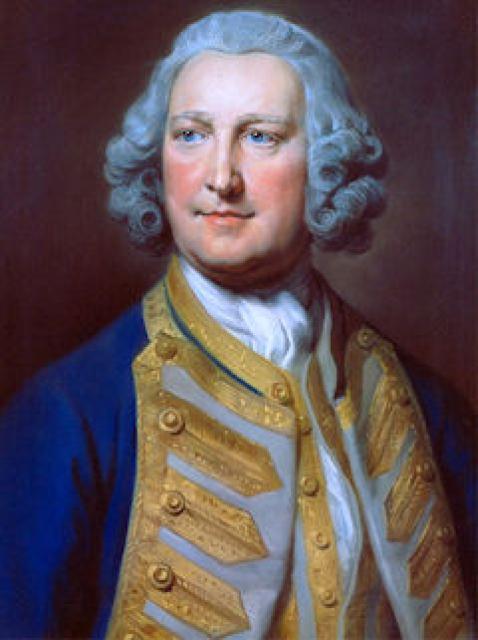
Jeorge Anson
 Great Britain
- Early Life and Naval Career
- Circumnavigation and the Capture of the Spanish Treasure Galleon
- The Journey to the Marianas
- The Return and Victory
- Later Career and Naval Reforms
Early Life and Naval Career
George Anson, 1st Baron Anson(April 23, 1697 - June 6, 1762) was a British Royal Navy admiral, First Lord of the Admiralty, and a prominent naval reformer. Born in Shugborough, Staffordshire, Anson joined the navy in 1712 and quickly rose through the ranks, becoming a captain in 1723.
Circumnavigation and the Capture of the Spanish Treasure Galleon
In October 1739, following Britain's declaration of war against Spain, Anson was appointed commander of a squadron tasked with raiding Spanish colonies in the Pacific. His expedition, known for its resilience and successes despite adversity, became renowned in naval history.
Anson's squadron consisted of the 60-gun "Centurion," the 50-gun "Gloucester" and "Severn," the sloop "Trial," and two provision ships, carrying a total of 1460 sailors and 470 marines. The squadron departed on September 18, 1739, visiting Madeira, the island of Santa Catarina off the coast of Brazil, San Julian Bay, and the Strait of Le Maire.
However, severe storms and poor living conditions at sea led to a loss of ships and lives. The "Severn" and the "Pearl" sank, while the remaining four were scattered. Unable to rendezvous at the intended port of Valdivia, Anson and the other ships made landfall at Juan Fernandez Island.
After recuperating, the squadron sailed to the Gulf of Panama in December. With three remaining ships, Anson raided the town of Paita and planned to attack Panama in conjunction with Admiral Edward Vernon. However, Vernon's failure at Cartagena forced Anson to pursue Spanish galleons in the Pacific on his own.
After an unsuccessful search, Anson burned three captured Spanish ships and transferred their cargo to the "Centurion" and "Gloucester." He then sailed to China to meet up with any British ships to replenish his crew and supplies.
The Journey to the Marianas
The journey to China took twice as long as expected, and the weakened crew struggled to handle the storm-damaged "Gloucester." Anson decided to transfer the valuable cargo to the "Centurion" and scuttle the "Gloucester." The "Centurion" was then blown off course to the north.
On August 26, 1742, the English sailors discovered Anatahan Island, followed by the Mariana Islands of Saipan, Tinian, and Agiguan on August 27. Learning from a captured Spanish sergeant that Tinian was uninhabited and abundant in provisions, Anson sailed there with his ship, which now had only 171 of its original crew.
Most of the crew were forced to disembark for treatment, leaving a small number of sailors to manage the ship. One day, the anchor cable snapped on coral, and the "Centurion" was carried away by the wind.
The Return and Victory
Adrift at sea with 113 men, including Anson and most of the officers, the crew was unable to signal for help due to weather conditions. However, Anson remained composed and ordered the repair and armament of a captured Spanish brig.
Nineteen days later, the "Centurion" returned. On October 21, the English resumed their journey and soon reached Macau, their first friendly port since the start of their voyage. After receiving provisions, Anson set sail for Batavia on April 19, but his true intentions were to intercept a Spanish galleon returning from Acapulco with a valuable cargo.
Despite having fewer than 200 sailors, including 30 boys, the crew attacked the well-armed galleon with determination. British gunfire ignited the sleeping mats on the galleon, and after two hours, the Spanish surrendered. The English captured gold coins, silver bullion, and other valuables worth a total of £400,000.
Anson sold the booty for £6,000 in Canton, marking the first British ship to visit Chinese waters. The "Centurion" departed for Europe on December 10 and arrived at Spithead on June 15, 1744. The returning crew was greeted with a hero's welcome, and the spoils were distributed among the officers and sailors.
Later Career and Naval Reforms
Anson was promoted to rear admiral upon his return and joined the Admiralty in 1744. In the War of the Austrian Succession against France and Spain, he commanded a combined British-Dutch fleet and achieved victories in the North Sea and the Atlantic.
In 1747, Anson commanded a squadron of 14 ships against eight weaker French ships at the Battle of Cape Finisterre. His signal for a general chase transformed the battle into a melee, resulting in a decisive victory. For his achievement, Anson was granted a peerage.
Anson participated in the Seven Years' War, commanding a squadron during the unsuccessful British raid on Saint-Malo and protecting British troops from the sea.
With the support of the Duke of Newcastle, Anson served as First Lord of the Admiralty from 1751 to 1756. Dismissed by William Pitt, he returned as First Lord from 1757 to 1762. He was promoted to admiral in 1761.
Anson implemented a system of fleet inspections, introduced a modern classification of naval ships, and established a uniform dress code for naval officers. He also developed a new naval code, which remained in effect until 1865, and founded a permanent corps of marines.
Anson died on June 6, 1762, in Moor Park, Hertfordshire. Known as the "Father of the British Navy" for his significant contributions to its development, his name has been borne by seven ships of the Royal Navy.


