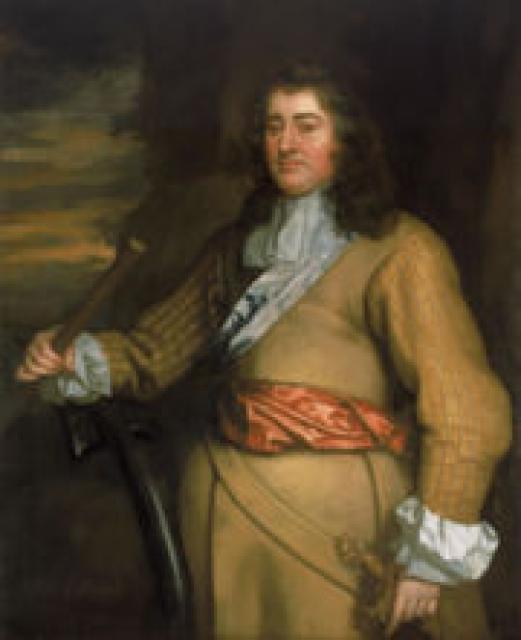
Jeorge Monk
 Great Britain
Biography of George Monck
George Monck (1608-1670) was a renowned military commander and naval leader of Great Britain. He is best known for his role as one of the most brilliant military commanders in British history. However, he was also a skilled naval strategist and a prominent political figure, often credited as the architect of the Restoration of England after the republican rule.
Early Life and Military Career
George Monck was born on December 6, 1608, in Great Torrington, Devon, into a prosperous Devonshire family. He initially fought against the Spanish in the Dutch army until 1638. He then participated in the suppression of the Irish rebellion in 1642-1643 and returned to England to fight for King Charles I against the Parliamentarians. However, he was captured in January 1644 and spent two years imprisoned in the Tower of London. After the defeat of the king in 1646, Parliament sent Monck to lead the army against the Irish rebels. He achieved limited success and reached a compromise with the rebels in 1649 before being forced to return to England. In 1650, Monck was sent by the Parliamentary commander to lead an infantry regiment to suppress the Scottish Royalists' uprising. He fought alongside Oliver Cromwell in the victorious Battle of Dunbar on September 3, 1650, and remained in Scotland to pacify the rebels. In November 1652, Monck was appointed one of the three "Generals at Sea" in the First Anglo-Dutch War, where he played a prominent role in three naval victories for the English.
Contribution to the Restoration
On the morning of June 12, 1653, Monck encountered Dutch Admiral Maarten Tromp near the Goodwin Sands. Each side had around a hundred ships. The battle began at 11 o'clock. At the start of the battle, Dutch Admiral Michiel de Ruyter, utilizing favorable winds, aggressively attacked the English vanguard, attempting to break their formation. However, he failed due to the superior condition of the English ships. Tromp rushed to help the damaged squadron of de Ruyter, turning the battle into a melee that lasted until 8 o'clock in the evening. During the night, Robert Blake's 18 ships joined Monck. The English resumed the battle in the morning. Taking advantage of the clashes between Dutch ships in the center, they captured 15 ships. By evening, the defeated Dutch fleet retreated to Vlissingen.
After the battle, Monck positioned himself between the Dutch squadrons of de Witt in Texel and Tromp in Vlissingen. However, Tromp managed to divert Monck's attention from Vlissingen to the sea, allowing de Witt to join Tromp. On August 10, their combined forces engaged the English fleet at the Battle of Scheveningen. The Dutch broke through the English fleet, turned around, and attacked. In the decisive battle, neither side achieved a significant victory. The death of Tromp, hit by a musket ball, proved to be a critical moment. The council of admirals and some officers on Monck's flagship decided not to strike the admiral's flag to avoid demoralizing the sailors and continued the fight. However, they failed to overcome the English, and by evening, the Dutch retreated to Texel and Maas. They lost 14 ships, with 500 killed and 700 wounded, while the English lost 9 ships, with 400 killed and 700 wounded. The English fleet was so badly battered that Monck had to return to his shores, ending the blockade.
In 1654, after completing a campaign against royalist rebels in Scotland, Monck remained there as the governor, by order of Cromwell, who had become Lord Protector of Great Britain. After Cromwell's death, Monck initially supported his son and successor Richard, but did not prevent his downfall. When Major General John Lambert forcibly dissolved Parliament in October 1659, Monck refused to recognize the new military regime and led his army from Scotland against Lambert in January 1660, earning the gratitude of the restored Parliament. After the dissolution of Parliament in March 1660, the new Parliament immediately invited King Charles II to return to England. The Declaration of Breda, which spoke of amnesty, freedom of conscience, and other measures, was issued at Monck's suggestion.
Restoration and Later Years
For his contribution to the peaceful restoration of the Stuarts, Monck was honored with the title Duke of Albemarle, appointed a Knight of the Order of the Garter, and granted a substantial annual pension. He also became the Master of the Horse, Lord Lieutenant of Ireland, and Captain-General. Shortly after, the Second Anglo-Dutch War broke out from 1665 to 1667, fueled by trade competition. In 1664, the English fleet seized Dutch stations on the west coast of Africa and New Amsterdam (New York) in America. The war was formally declared in February 1665. Expressing the prevailing sentiment in England, Monck declared, "Doesn't it matter what pretext we choose? The essence of the matter is that we want to capture the majority of the trade currently controlled by the Dutch."
Monck commanded the fleet in two major battles in 1666: the Four Days' Battle in the English Channel from June 11 to June 14, and the St. James's Day Battle off North Foreland on August 4. In June 1666, Monck was the overall commander of the English fleet. The English had 80 ships, while the Dutch, commanded by de Ruyter, had around 100, but mostly smaller ones. However, this approximate equality was disrupted. Upon learning of the French squadron's movements to aid the Dutch from the Atlantic, the king sent a squadron led by Prince Rupert to intercept them. Monck led the remaining 60 ships to confront the Dutch. This placed the English fleet in a precarious position. On the morning of June 11, 1666, Monck discovered the Dutch fleet, anchored leeward in the Pas-de-Calais between Dunkirk and the Downs. Despite his numerical disadvantage, he decided to attack, hoping that the windward position would allow him to disengage if necessary. Monck's rear guard fell behind, but he led 35 ships to bypass the Dutch vanguard and center and attacked the Dutch rear guard. Tromp immediately cut his anchor cables and formed a line parallel to the English, with the center and vanguard following suit but remaining too far to engage. The engaged ships moved toward the shores of France.
The wind severely hindered the lower deck guns of the English ships from firing. Nevertheless, the English burned a large Dutch ship. However, when the English vanguard, after turning near Dunkirk, encountered the Dutch center, the ships in the elongated lines became mixed up. The English commander-in-chief continued to fight until late, losing two ships against one Dutch ship, but managing to hold his position and preserve the combat readiness. The next morning, Monck, taking advantage of his superior speed, gained the windward position. He had 44 ships against 80 enemy vessels. The opponents were sailing on opposite tacks. The Dutch ships, arranged in two or three lines, hindered each other's fire. Seeing that the situation was unfavorable, the commander of the Dutch rear guard, Tromp, turned and sailed against the wind of the English vanguard. However, two flagship English ships turned their sterns to the enemy and Monck followed them to avoid breaking formation. Tromp found himself in danger as his ships were cut off from the main English forces by the line. De Ruyter saved him by turning the vanguard and center behind the rear guard. Monck did not dare to engage Tromp's small forces, as he could not risk giving the wind advantage to his opponent. He did not seize the opportunity to surround the Dutch ships, as the English ships, maintaining their formation, had significant damage to their rigging, reducing their maneuverability.
On June 13, Monck continued to retreat. He burned three disabled ships, sent the damaged ones ahead, and formed a rear guard with the most combat-ready vessels. During the retreat, the 90-gun ship "Royal Prince" ran aground and was captured by the Dutch; however, they suffered significant losses themselves and did not inflict much damage on the enemy. By evening, Rupert's squadron approached, significantly increasing Monck's forces.
The following morning, a fresh southwest wind favored the Dutch. However, Monck, relying on the speed of his ships, sailed around the enemy from astern and engaged in battle. The English fleet was windward. The opponents attacked with fire ships, but the poorly maneuverable Dutch ships did not cause significant damage to the enemy, while the English burned two ships. The fleets fought for two hours on parallel courses, after which the main forces of the English fleet crossed the Dutch line. The opponents became mixed up, and the majority of the Dutch forces, led by de Ruyter (35-40 ships), ended up windward, while a significant portion of the English forces, led by Monck, were leeward. Four ships from the English vanguard tried to go windward of the enemy, and the Dutch vanguard chased them. Tromp followed them, as he was left downwind due to the maneuvering of the English main force. Tromp found himself isolated among the English ships. The Dutch, attacked from both sides, became disoriented and disrupted their formation due to the enemy's attacks and the strong wind.
In the heat of battle, Monck, accompanied by a single fireship, drifted away from the fleet. However, he managed to gain the wind and, passing through the Dutch squadron, found himself once again leading 15-20 English ships. The English lost 17 ships, while the Dutch lost 4.
A contemporary observer wrote that throughout the battle, the English fleet maintained its formation. Their defeat was a result of the initial division of forces, as the attack by Monck and Rupert's combined squadrons against the Dutch fleet, which was not in the best shape, could have led to its complete destruction before its junction with the French. The wise and energetic efforts undertaken by the government of the United Provinces and the indisputable superiority of de Ruyter in experience and talent over all his opponents could not offset the weakness and incompetence of most Dutch officers and the apparent inferiority of their crews.
Aftermath and Later Life
Two months later, on August 4, a fierce battle took place off North Foreland, where Monck's English fleet defeated the retreating Dutch fleet near their shores. Negotiations for peace commenced. However, King Charles II was demanding too much from the Netherlands. On the other hand, he believed that a large fleet was unnecessary and ordered its disarmament, leaving only cruising frigates at sea. Monck opposed this imprudent decision. He proved to be right when, on June 14, 1667, the Dutch fleet, under the command of de Ruyter, entered the Thames, destroyed ships, captured the Sheerness and Chatham, and remained on the river until the end of the month. The fires visible from London compelled Charles II to conclude the Treaty of Breda on July 31, 1667.
George Monck passed away on January 3, 1670, in London. His famous expression that a nation desiring maritime dominance should always attack set the tone for England's naval policy.


