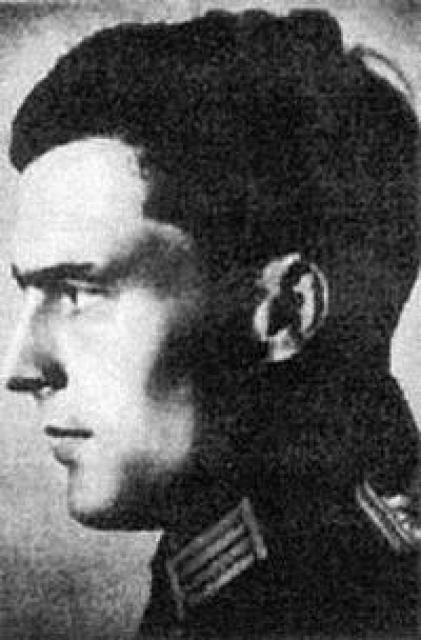
Henning Treskov
 Germany
- Biography of Henning von Tresckow
- Early Life and Military Career
- Opposition to the Nazis
- World War II and Resistance
- Involvement in the Conspiracy
- Death and Legacy
Biography of Henning von Tresckow
Henning Hermann Robert Karl von Tresckow (January 10, 1901, Wartenberg Estate near Magdeburg – July 21, 1944, Ostrov, near Białystok, Poland) was a German Army Major General (1944) and one of the active participants in the conspiracy against Adolf Hitler.
Early Life and Military Career
Henning von Tresckow was born into a Prussian noble family and received his education at home and at the boarding school of Lockum Monastery. At the age of 16, he voluntarily joined the army during World War I. He served in the 1st Guard Infantry Regiment and participated in battles on the Western Front. In 1918, he was promoted to lieutenant and was awarded the Iron Cross in July. In 1919, he served in the Freikorps, a paramilitary organization fighting against left-wing radical forces and took part in suppressing the revolutionary movement in Berlin. After being demobilized in 1920, he studied banking and later attended the Faculty of Law at the University of Berlin while working successfully as a stockbroker. He also embarked on a year-long trip abroad.
Opposition to the Nazis
In 1924, von Tresckow joined the Reichswehr and was commissioned as a lieutenant in the 9th Infantry Regiment in Potsdam. Initially, he sympathized with the Nazi party like many of his peers but distanced himself from them after the "Night of the Long Knives" in 1934. In 1936, he graduated first in his class from the military academy and was assigned to the Operations Department of the General Staff. It was there that he became aware of the dangers Germany faced in fighting a two-front war and became an opponent of the Nazis' aggressive foreign policy. After the crisis at the beginning of 1938, when opponents of aggression were forced into retirement, von Tresckow established contacts with secret opposition groups aiming to remove Hitler from power.
World War II and Resistance
During the Polish campaign in 1939, von Tresckow served as the Chief of Operations Staff in the headquarters of the 118th Infantry Division and was awarded the Iron Cross 1st Class for his combat achievements. In mid-October 1939, he was appointed to the staff of Army Group A, which was responsible for planning operations in France. From 1941, he served as the Chief of Operations Staff in the headquarters of Army Group Center on the Eastern Front. He strongly opposed the repression of Jews and political officers by the Red Army and tried to protest against these orders. Von Tresckow warned his colleague, Colonel Baron Rudolf von Gersdorff, that if the orders to execute commissars and "suspicious" civilians were not rescinded, Germany would lose its honor, which would be remembered for hundreds of years. He believed the blame would fall not only on Hitler but also on himself, Gersdorff, their wives, and their children.
Involvement in the Conspiracy
In October 1943, von Tresckow became the commander of a regiment, and the following month, he was appointed as the Chief of Staff of the 2nd Army. He was awarded the German Cross. Since 1942, he had been planning Hitler's assassination and established contact with members of the conspiracy in Berlin in February of that year. He was one of the main organizers of the failed assassination attempt on Hitler in Smolensk on March 13, 1943 when a disguised package bomb was placed on the Führer's plane, which failed to explode due to a faulty detonator. Von Tresckow unsuccessfully attempted to arrange his transfer to Hitler's headquarters, hoping to organize an assassination there. In late 1943, von Tresckow asked Field Marshal Erich von Manstein, who highly valued him as a capable staff officer, to transfer him to the staff of Army Group South, hoping it would aid in the assassination plot. However, Manstein, aware of von Tresckow's outspoken anti-Nazi views, refused his request.
Death and Legacy
Upon learning of the failed anti-Nazi coup on July 20, 1944, and realizing his inevitable arrest, von Tresckow told Fabian von Schlabrendorff, another participant in the conspiracy, "They will soon find out about me and try to extract the names of our comrades from me. In order to prevent this, I must sacrifice my life." Schlabrendorff was unable to convince him to reconsider his decision and von Tresckow tried to disguise his suicide by imitating combat before detonating a hand grenade.
Von Tresckow's remains were initially buried in his homeland, but when his role in the conspiracy was discovered, they were exhumed and incinerated in the Sachsenhausen concentration camp crematorium. His family members faced repression as a result.
In modern Germany, von Tresckow is considered a hero of the anti-Nazi resistance, and a barracks of the Bundeswehr is named in his honor.


