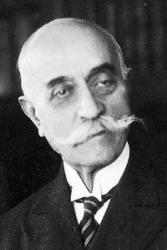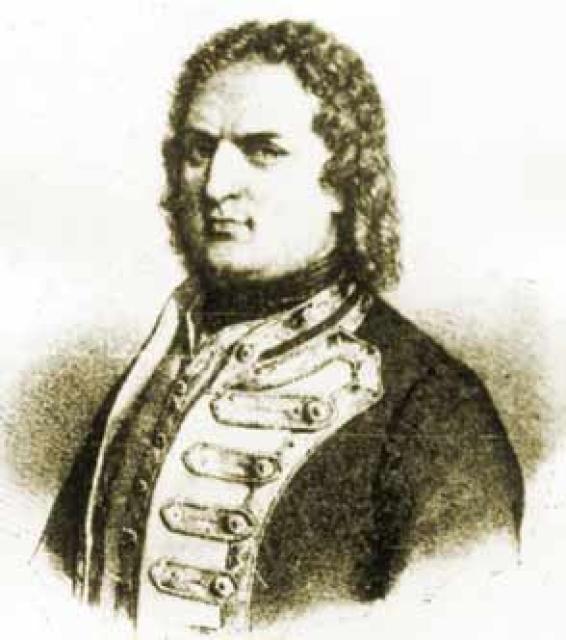
Jeorge Rodney
 Great Britain
Biography of George Rodney
George Bridges Rodney, an English admiral (1778), was born in February 1718 and baptized in London on February 13th. He came from a military family, and after attending Harrow briefly, he joined the navy in July 1732 and became a lieutenant in 1739. During the War of the Austrian Succession (1740-1748), he participated in Admiral Hawke's victory over the French fleet on October 14th, 1747. In 1749, he was appointed governor and commander-in-chief of Newfoundland.
Rodney rose to prominence during the Seven Years' War (1756-1763) when he commanded the line-of-battle ships "Eagle" and "Dublin." He took part in the expedition against Rochefort in 1757 and served under Admiral Boscawen in the capture of Louisbourg in Cape Breton the following year. In July 1759, Rodney's squadron blockaded Le Havre and burned the amassed naval supplies, as well as the fleet of landing and transport ships. In 1760, he inflicted significant losses on French transports gathered on the shores of Normandy for an invasion of Great Britain.
In October 1761, Rodney was appointed commander-in-chief of the Leeward Islands station, and his squadron arrived in Barbados on November 22nd. Joining forces with 41 ships and 14,000 troops, Rodney seized the island of Martinique, a crucial French base, on February 12th, 1762. From Fort Royal in Martinique, numerous privateers set sail during the Seven Years' War, capturing 1,400 vessels. Grenada, St. Lucia, and St. Vincent were subsequently taken, securing trade for the British island colonies. In 1764, Rodney was made a baronet, and in 1771, he became a rear-admiral. He was promoted to admiral in 1778.
However, due to his vices and financial difficulties, Rodney lived in France. When the war began, he claimed to be capable of defeating the French fleet and a French nobleman provided him with the funds to return to England, assuming his debts out of wounded national pride. Rodney was not joking. Upon his immediate return, he was given a squadron and sailed to rescue the besieged Gibraltar.
In December 1779, Rodney's squadron, consisting of 20 ships and 100 transports, departed from Plymouth to deliver reinforcements and supplies to the Mediterranean. On January 8th, 1780, while encountering 16 Spanish transports protected by a ship and six frigates near Cape Finisterre, Rodney engaged in battle and captured all the military and cargo vessels. On January 16th, at Cape St. Vincent, a Spanish squadron of 11 ships and two frigates was discovered. Spanish Admiral Don Juan de Langara initially believed he was facing an unguarded convoy, but when he realized his mistake, it was too late. Taking advantage of the speed of his copper-plated ships, Rodney pursued and attacked the enemy, cutting them off from Cadiz. After a 10-hour battle, the British exploded one Spanish ship and captured six others, including the Spanish commander-in-chief. On January 22nd, Rodney's convoy reached Gibraltar. Not encountering the Spanish fleet, which had gone for repairs in Cadiz, the admiral unloaded the supplies in Gibraltar and the island of Minorca without hindrance. This success prompted his appointment to the West Indies, where the British had lost several islands due to successful actions by the French fleet. On February 13th, with four ships, Rodney set sail for the West Indies, returning the remaining ships to England with Admiral Digby.
On March 27th, 1780, the new commander-in-chief in the West Indies arrived at the island of St. Lucia, where Admiral Hyde Parker had 16 ships of his squadron stationed. In March 1780, a French squadron under Rear-Admiral de Guichen arrived in the West Indies. On April 17th, Rodney, commanding 21 ships, encountered de Guichen's fleet of 23 ships in a battle between Dominica and Martinique. Throughout the day, Rodney's maneuvers allowed him to gain a windward position, and he signaled his fleet to attack the enemy's center and rear guard with all their might. However, de Guichen recognized the danger and turned to assist the rear guard. After noon, Rodney once again gained a favorable position and began his attack. As the French fleet stretched out, Rodney ordered his ships to attack those that were in line with them at that moment. However, due to signaling book deficiencies and the inertia of the commanders, some ships raised their sails, trying to take a position on the traverse of the ship corresponding to their number in the line. As a result, the plan to put two-thirds of the enemy fleet under attack by the entire British fleet failed. During the battle, Rodney on his flagship approached a French ship and bombarded it so relentlessly that he disabled the enemy vessel. The admiral attempted to break through the enemy's formation, but a decisive attack by the commander of the French ship "Destin" prevented him from doing so. Neither side achieved an advantage. De Guichen encountered Rodney two more times the following month but avoided taking a leeward position, fearing Rodney's determination. The English flagship failed to intercept 12 Spanish ships of the line that de Guichen met and escorted to Martinique. However, the epidemic among the Spanish crews and the lack of coordination prevented the allies from achieving success despite their numerical superiority. In August, de Guichen sailed back to France. Unaware of the French fleet's destination and fearing for North America, Rodney took a deadly risk: he left half of his forces in the West Indies and went to New York with the remaining ships. The English were justified in their concerns, as on July 12th, 5000 troops under the command of Rochambeau and seven ships of the line commanded by de Ternay arrived from France. With their superior naval strength, the British were forced to abandon operations in Carolina and concentrate their forces in New York.
In the late autumn of 1780, Rodney returned to the West Indies. Upon learning of the declaration of war with the Netherlands on December 20th, he captured the Dutch islands of St. Eustatius and St. Martin, which had been involved in smuggling during the war. The English acquired numerous ships with valuable cargo worth up to 15 million dollars. In the spring of 1781, de Grasse arrived in Martinique. As Rodney remained on the island of St. Eustatius, his subordinate, Rear-Admiral Hood, blockaded Fort Royal, the French port and arsenal. Hood, however, failed to prevent de Grasse from joining the ships in Martinique. Rodney, unaware of the French fleet's movements, sent frigates to sea. Upon learning of de Grasse's departure from Martinique on April 8th (33 ships and transports with troops), he left St. Lucia on the same day with 36 ships. On the morning of April 9th, the opponents spotted each other. De Grasse immediately sent the transports to Guadeloupe and maneuvered in the channel between Guadeloupe and Dominica. The English were delayed by calm winds but gradually gained speed due to their copper-bottomed hulls. The French tried to engage in battle at a distance because the English had a significant advantage with carronades at close quarters. The exchange of fire lasted for two hours. When the English rear guard entered the scene from the windless zone, de Grasse withdrew from the battle.
On April 10th, the English squadron was engaged in repairs, and Rodney switched the more damaged vanguard with the rear guard. The French fleet maneuvered incorrectly between Dominica and the Isles des Saintes from April 9th to 12th. Due to collisions, two ships were disabled and sent for repairs. On April 11th, the English spotted two damaged French ships. Rodney pursued them. De Grasse descended again to cover his ships, and Rodney finally gained a windward position. However, the wind changed, allowing the French fleet to pass in front of the enemy. The English vanguard turned and sailed alongside the French ships. Rodney, on the advice of his flag officer, decided to cut through the French line with his ship. As the French battle line had gaps due to its maneuvers, Rodney, with five ships following him, entered one of the gaps, cutting off the vanguard from de Grasse, while the sixth English ship passed through the second gap, taking the rear guard with it. As a result, the French formation was split into three parts, disabled against the wind, and never fully restored during the battle. The center was separated from the vanguard and rear guard by at least two miles. De Grasse's attempt to line up in light winds interrupted by calms led to the most damaged ships falling behind, and the English captured five ships, including the flagship. The approaching tropical night forced Rodney to break off the pursuit, allowing the remaining 25 French ships to regroup and escape to the island of Santo Domingo.
The Battle of the Saintes showcased the tactics proposed by John Clerk. Its basis was to break through the enemy's line to rupture one part before the other could come to its aid. Later, Charles Douglas, the son of Rodney's chief of staff, argued that it was his father who initiated the breakthrough and that he had a hard time persuading the admiral. Rodney's victory was not complete. Sir S. Hood expressed his belief to Rodney the next day that they could have taken not just five but 20 ships, and Douglas, disappointed by the admiral's response to his advice, was ready to resign. Rodney himself explained the cessation of the pursuit due to damage to his ships and other circumstances. However, as a result of the battle, the allies were forced to abandon the landing in Jamaica, and the capture of de Grasse effectively ended the fighting in the West Indies.
With a change of government in England, Rodney, a former extreme Tory, was replaced by another sailor. He went to the West Indies before news of the victory arrived, which reconciled the British with some aspects of the admiral's previous behavior. After the signing of the Treaty of Versailles, Rodney returned to England, received gratitude from Parliament, and was made a peer and baron with a lifetime pension.
Admiral Rodney died in London on May 24th, 1792. British warships were named in his honor.