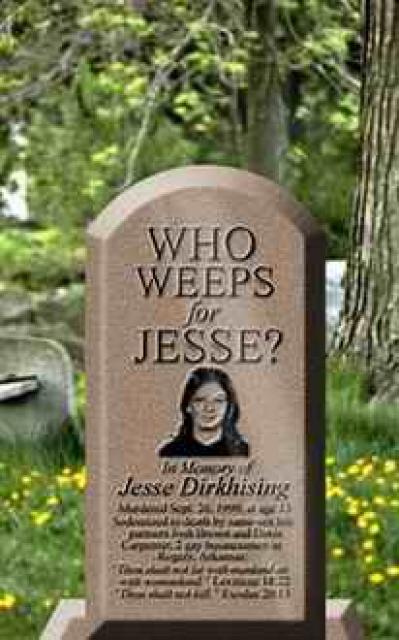
Jesse Dirkhising
 USA
USABiography of Jesse Dirkhaising
Jesse Dirkhaising was a young boy who tragically became the victim of sexual assault and abuse at the hands of two homosexual pedophile lovers who were under the influence of drugs. He passed away in a hospital due to asphyxiation.
On September 26, 1999, a police patrol called to the home of 38-year-old Davis Carpenter discovered Jesse, a 13-year-old boy, bound and confined. Joshua Brown, a 22-year-old man, was also present in the house alongside Carpenter. The police investigation revealed that the child had been sexually assaulted for several hours before being found. Although he received immediate medical attention, Jesse sadly died in the hospital as a result of asphyxiation.
The investigation further revealed that the perpetrators had subjected Jesse to sexual violence using various objects, including their genitalia, three fingers at once, a cucumber, a sausage, bananas, and a bottle.
In the months leading up to his murder, Jesse had been spending weekends with Carpenter and Brown with the permission of his mother, Tina, and stepfather, Miles Waits. Jesse's parents and his grandmother, Paula McVey, were aware of the homosexual relationship between Carpenter and Brown.
Carpenter had been considered a friend by Jesse's mother and stepfather for several years. Jesse's grandmother believed that he was earning money by fixing cars and sweeping floors at the hair salon where Carpenter worked.
In a video interview, Davis Carpenter claimed that he had given advice to Jesse about his sexuality, stating, "Jesse was confused: he was attracted to guys and he hated himself for it." According to Carpenter, Jesse's mother had previously mentioned her son's homosexuality during conversations with him. Carpenter himself had run away from home at the age of 15 due to his own sexual orientation, as his father and family believed that homosexuals should be killed. Carpenter's father later changed his viewpoint and accepted his son's orientation.
Carpenter stated that they did not engage in bondage in their sexual relationship with Brown, but their activities, which Jesse participated in, included a "mummy game" where they wrapped each other in tape.
Joshua Brown referred to Jesse as his "secret lover" and claimed that on their very first weekend together, Jesse engaged in oral sex with him without his consent. He also insisted that he had never engaged in anal sex with Jesse until the incident occurred. In his confession, Brown stated that they were just "playing" with Jesse's consent and that he did not know such a "game" could kill a child.
When asked by police if Carpenter had ever fantasized about having sex with children, Brown affirmed it but denied that such acts had occurred in reality. Numerous notes depicting pedophilic fantasies were found in Brown and Carpenter's house.
The most significant difference between the Shepard and Dirkhaising cases is that Shepard's murder was driven by hate and prejudices, while Jesse's murder was a sexually motivated crime. Essentially, Shepard was lynched - he was abducted, beaten, and left to die because he was different, one of those who often face attacks with silent consent from others. The abuse of minors is not something extraordinary and is almost daily featured in the news, while lynching becomes a tragedy for the entire country.
Although the District Attorney sought the death penalty, the perpetrators were sentenced to life imprisonment. This means that according to state laws, they could be released in 15-20 years with good behavior. Meanwhile, Matthew Shepard's killers received two life sentences without the possibility of appeal and are serving their sentences under strict conditions (solitary confinement and minimal time outside the cell). Jesse's killers are held in a general population prison.
Dirkhaising's murderers were charged with murder and sexual assault, whereas Shepard's killers were prosecuted for kidnapping and robbery.
After Shepard's murder, there were over 3,000 publications in American newspapers in a month, while there were only about 50 after Jesse's murder. However, once this story came into the spotlight of the media, the count reached thousands - much more than in other child murder cases.
According to some witnesses, Shepard purchased drugs (and possibly engaged in sexual relations) from one of his killers. McKinney, Shepard's murderer, vehemently denied these claims in court. In the case of Jesse, according to Brown's sworn statement to the Arkansas State Police, he engaged in oral sex with the victim with Jesse's consent as early as two months before the murder. The second perpetrator stated that "Jesse's mother knew that her son was homosexual and was also aware of the killers' homosexuality." American journalist Patrick Buchanan cites the opinion of commentator Brent Bozell:
"If Jesse Dirkhaising had been shot in an Arkansas school, it would have immediately become a national event. Had he been a homosexual and his killers heterosexual, the crime would have been shouted from every corner. But no liberal media outlet dared to be the first to report on a crime in which the perpetrators were homosexuals."
On November 4, 1999, journalist Jonathan Gregg questioned the lack of publicity surrounding Jesse's murder in an issue of the popular American magazine "Time." He wrote, "Could it be that we, the elite of the media business, did not want to widely cover crimes committed by homosexuals because it did not fit our agenda? The next logical step in this line of reasoning would be to assume that all news is controlled by a group of people loyal to homosexuals who enthusiastically advocate double standards."
According to Jonathan Gregg, the limited media coverage of the crime was due to the fact that no lessons could be learned from it. Shepard's murder touched upon a complex set of urgent issues: intolerance, society's attitude towards gays, and the use of violence as a response to temptation. The death of Jesse Dirkhaising gives us nothing but the debauchery and immorality of two mentally ill individuals. There is no lesson, no morality about tolerance, and we gain no hope from the punishment of the perpetrators.
Opponents of Gregg's viewpoint argue that it only reflects the double standards of the media, that they serve political rather than public interests. Shepard's murder was sensationalized by the media because it was beneficial to homosexuals, while Dirkhaising's murder was silenced because it could harm homosexuals.