John Hawkins
 Great Britain
- John Hawkins, English Privateer and Slave Trader
- Successful Expeditions and International Controversy
- The Ill-Fated Fourth Expedition
- Battle of San Juan de Ulua
- Conspiracy and Revenge
- Later Career and Legacy
John Hawkins, English Privateer and Slave Trader
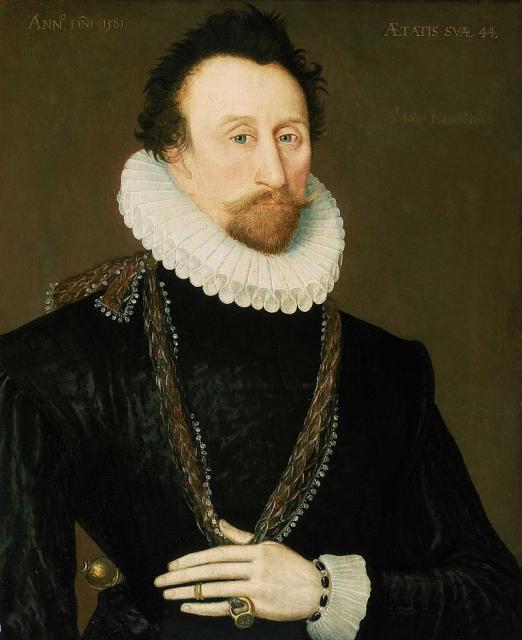
Early Life and First ExpeditionsJohn Hawkins(1532-1595) was a renowned English privateer, slave trader, and member of Queen Elizabeth I's "Sea Dogs." Born into a wealthy merchant family in Plymouth, he initially followed his father's footsteps in maritime trade. However, Hawkins's ambitious nature led him to pursue a different path.
In the 1560s, Hawkins convinced London merchants to invest in slave trading expeditions. He equipped two large ships and a smaller vessel and sailed to the African coast. There, he captured Portuguese slave ships and enslaved their cargo. Hawkins then transported the slaves to the West Indies, where he exchanged them for colonial goods, which he sold in England for a substantial profit.
Successful Expeditions and International Controversy
Hawkins's success emboldened him to embark on subsequent expeditions. His third voyage, which included the 700-ton flagship "Jesus of Lubeck," also targeted the West Indies. Despite Spanish prohibitions, Hawkins used cunning and force to trade slaves for pearls, gemstones, silver, and gold.
However, Hawkins's exploits sparked international outrage. The Spanish ambassador in England protested, and Hawkins was summoned to the Admiralty and ordered to cease his West India voyages. Undeterred, Hawkins secretly organized a fourth expedition, financed in part by Queen Elizabeth I and several members of Parliament.
The Ill-Fated Fourth Expedition
This expedition, led by Hawkins and a young Francis Drake, faced a series of setbacks. A severe storm damaged the ships, and at the Senegal River, they were attacked by African warriors armed with poisoned arrows. Hawkins sustained a life-threatening wound, but he managed to recover, while several of his crewmates died.
Eventually, Hawkins found a cooperative African chief who helped him capture 600 enslaved people. He then sailed to South America, divided his fleet, and proceeded with the slave trade. Drake's encounter with the Spanish in Rio de la Hacha escalated into a raid and the sacking of the city.
Battle of San Juan de Ulua
Hawkins's fleet arrived in San Juan de Ulua, Mexico, seeking a market for his remaining slaves. The Spanish viceroy, Martin Enriquez, initially promised safe passage but then ordered the harbor to be blocked. Hawkins refused to leave, and a tense stand-off ensued.
A skirmish erupted, resulting in the loss of several ships on both sides. The Spanish attacked with fire ships, and Hawkins sacrificed his largest ship to break the blockade. Only two of Hawkins's vessels managed to escape, "Judith" under Drake's command and "Minion."
Conspiracy and Revenge
Hawkins returned to England after a perilous journey. The plight of his crew members captured in Mexico haunted him. Driven by anger, he joined a plot against Queen Elizabeth I. His involvement was so convincing that the Spanish ambassador believed him and interceded with King Philip II to compensate Hawkins for his losses.
Hawkins used this guise to negotiate the release of the captives and received a substantial sum from the Spanish. In return, he informed the English government of the conspiracy, leading to the expulsion of the Spanish ambassador.
Later Career and Legacy
Hawkins focused on his political career and served as a Member of Parliament, Treasurer of the Navy, and Comptroller of the Navy. He continued to support and profit from privateering expeditions. He played a vital role in the defeat of the Spanish Armada, for which he was knighted.
Together with Drake, Hawkins founded a hospice for retired mariners, which later expanded to include a hospital. The hospital still stands today, bearing his name.
Despite his later accomplishments, Hawkins died in combat on an expedition with Drake in the Caribbean in 1595. He left an enduring legacy as a ruthless yet resourceful seafarer who shaped the history of piracy and slavery.