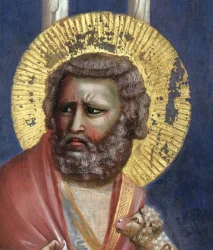
Joachim
- A story preserved outside the Bible
- The story’s meaning and limits
- Veneration across Christian traditions
Joachim is remembered in Christian tradition as the father of Mary, the mother of Jesus, and the husband of Anne. Unlike many figures in religious biography, he does not appear in the New Testament. His name and story come from later Christian writing, where he became part of a cherished account of Mary’s family and childhood.
A story preserved outside the Bible
The earliest surviving narrative about Joachim appears in the second-century Protoevangelium of James, also called the Infancy Gospel of James. The work is not part of the biblical canon, but it became influential in Christian tradition. It describes Joachim and Anne as a devout couple who had no children and felt the pain of being unable to continue their family line.
In the account, Joachim withdraws to the wilderness to pray, while Anne grieves at home. An angel announces that they will have a child, and the couple later reunites. Their daughter is Mary. The narrative goes on to describe Mary’s early childhood and her dedication to God. These episodes supplied details that the canonical Gospels leave unrecorded.
The story’s meaning and limits
The Protoevangelium presents Joachim as a righteous and generous man whose prayers are answered after a period of hardship. Its account helped early Christians imagine the circumstances of Mary’s birth and emphasize her special role. Later infancy narratives, including the Gospel of Pseudo-Matthew, expanded on the story and helped carry it through medieval Christian culture.
Because Joachim is known through these later religious texts, historians cannot verify his life as they might that of a figure documented in contemporary records. The story is best understood as a statement of Christian belief and devotion rather than as a detailed historical biography. The names Joachim and Anne became widely accepted in Christian tradition, even though the New Testament does not identify Mary’s parents.
Veneration across Christian traditions
Joachim came to be honored alongside Anne in both Eastern and Western Christianity. Churches developed feast days commemorating the pair, and their story inspired icons, paintings, and devotional writing. In the Roman Catholic calendar, the feast of Saints Joachim and Anne is celebrated together on 26 July. In Eastern traditions, Joachim and Anne are also honored in connection with the feast of Mary’s birth.
For believers, Joachim represents faithful endurance and trust through disappointment. For historians, he is a figure whose importance lies in the powerful reception of an early Christian story. The tradition that made him Mary’s father shaped how generations imagined the family life behind the Gospel narratives, even though the historical details remain beyond verification.