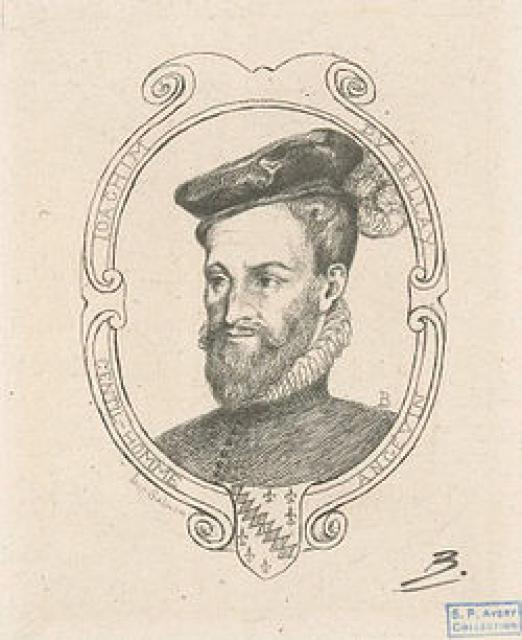
Joachim Du Bellay
 France
Biography of Joachim du Bellay
Joachim du Bellay, also known as Joachim du Bellay, was a French poet who lived from 1522 (1525, according to other sources) to January 1, 1560. He was born in the castle of Turmelière near Liré, Anjou, France. Du Bellay was a prominent poet of the 16th century and a member of the poetic group "La Pléiade," as well as the closest friend of its leader, Ronsard.
Early Life and Career
Du Bellay was born into a noble family but lost his parents at a young age. He engaged in self-education and belonged to the Catholic clergy, holding high positions within the church. However, after meeting Ronsard in 1547, he decided to abandon his ecclesiastical career and dedicate himself entirely to poetry.
From 1547 to 1549, Du Bellay studied alongside Ronsard and Jean-Antoine de Baïf at the College of Coqueret. During this time, he actively pursued poetry. In April 1553, he obtained a position as secretary to his cousin, Cardinal Jean du Bellay, who was appointed as an ambassador to Rome. Du Bellay accompanied him to Italy and stayed there until August 1557. Upon his return, he published several collections in 1558.
Works and Influence
Du Bellay's works greatly contributed to the enrichment of the French literary language and the creation of new genres such as ode, elegy, and epic. He also wrote the first French satire against court poets titled "The Court Poet." As a poet, Du Bellay imitated Petrarch, and the main themes of his collection "The Olive" ("L'Olive") were borrowed from Italian poets. Du Bellay spent a significant amount of time in Italy, where he wrote his best poem "Antiquités de Rome" and the verses "Les Regrets," which are particularly characteristic of his intimate lyricism. In 1552, he published a translation of the fourth book of Virgil's "Aeneid" (the sixth book was published posthumously in 1560). After 1553, Du Bellay moved away from Petrarchism and transitioned to realistic lyrics.
In 1549, he wrote a treatise titled "The Defense and Illustration of the French Language" ("La défense et l’illustration de la langue française"), which later included fragments from the preface of his collection "The Olive." This treatise developed the main theoretical principles of the new group of writers. While the main aesthetic principles of this movement are often attributed to Ronsard, Du Bellay is considered the main polemicist of "La Pléiade," one of the reformers of the French language and poetry. His ideas were further developed by his friend Jean de Tailly. Du Bellay was an opponent of the overly sentimental and rhymed poetry of the court poets. In the polemical part of his treatise, he declared war against all medieval poetry, criticizing blind imitators of ancient poets who abused Latin. He advocated for the serious study of classical literature and bringing French poetry closer to the simplicity of folk creativity. However, these tendencies towards "popularity" did not develop due to the courtly and aristocratic nature of the works of "La Pléiade." The main influence came from books, especially Italian ones, which greatly influenced Du Bellay's treatise. There is even an indication that the entire polemical part of "The Defense" was borrowed from an Italian source.
Du Bellay's poetic work often contradicted his theories. Despite being a proponent of "objective" poetry, he was the most subjective poet of the entire group. Going against Latin and imitation, he left behind two volumes of Latin verses and imitated foreign models extensively. However, these contradictions were characteristic of the entire "La Pléiade" group as a whole.