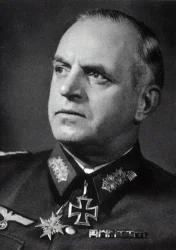
Joachim Peiper
Joachim Peiper was a senior Waffen-SS officer whose career rose alongside the Nazi regime and ended in criminal conviction and a violent death. He commanded combat units on the Eastern and Western Fronts, and troops under his command committed war crimes in the Soviet Union, Italy and Belgium. His name is most closely associated with the Malmedy massacre, in which German forces killed American prisoners of war during the Battle of the Bulge.
Early SS Career
Peiper was born in Berlin on 30 January 1915. As a teenager after the Nazi takeover, he joined the Hitler Youth and entered the SS in 1933. At a Nazi Party rally the following year, he met Heinrich Himmler, head of the SS, who helped steer him toward a full-time career in the organization. In 1936 Peiper joined the Leibstandarte SS Adolf Hitler, an elite formation that became the 1st SS Panzer Division.
From 1939 to 1941 he served as one of Himmler’s adjutants. The role gave him close access to the SS leadership and exposed him to the regime’s escalating racial policies and violence. He later transferred to the Waffen-SS combat arm, where he commanded battalions and then a regiment. His units fought on the Eastern Front, in Italy and in Western Europe.
War Crimes and the Malmedy Massacre
During the war, Peiper’s formations were responsible for serious crimes, including killings of civilians and prisoners. In Italy in 1943, members of his battalion were involved in the massacre of civilians at Boves. During the December 1944 Ardennes offensive, he led a mobile battle group that pushed through Belgium as part of Germany’s last major attack in the west.
On 17 December, troops from Peiper’s battle group captured American soldiers near the Belgian town of Malmedy. About 80 prisoners were shot. Peiper was not physically present at the shooting, but he commanded the unit responsible, and investigators linked his formation to additional killings of prisoners and Belgian civilians along its route. The killings became known as the Malmedy massacre and shocked the Allied forces.
After Germany’s defeat, U.S. authorities prosecuted Peiper and dozens of other Waffen-SS personnel at Dachau. In 1946, a military tribunal sentenced him to death. The trial later became controversial because defendants alleged coercive interrogation methods and the handling of evidence was criticized. Those disputes shaped the legal aftermath, but they do not erase the killings committed by the unit under his command. Peiper’s sentence was commuted to life imprisonment in 1951, and he was released from Landsberg prison in 1956.
Postwar Life and Death
After his release, Peiper worked in the automobile industry and later for a publisher. He also remained active in HIAG, a veterans’ organization that campaigned to rehabilitate the Waffen-SS and present its members as ordinary soldiers. In 1972 he moved with his wife to Traves, in eastern France, where he worked as a freelance translator and sales trainer.
His Nazi past became public in France in 1976, prompting calls for his expulsion. On the night of 13–14 July, his house was set on fire and Peiper died inside. French authorities investigated the arson, but no one was prosecuted. He was 61.
Historical Assessment
Peiper’s image was shaped by postwar mythmaking that recast SS officers as daring professional soldiers while minimizing their role in Nazi crimes. The historical record is less romantic: he joined the SS early, served close to Himmler, commanded units implicated in atrocities and was convicted by a military court. The Malmedy massacre remains a central part of his legacy, not an incidental episode in a battlefield legend.