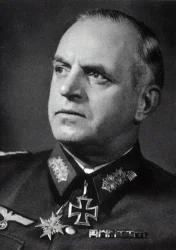
Friedrich Fromm
- An Officer and Organizer
- A Reluctant Connection to the Resistance
- 20 July and Its Aftermath
- Historical Assessment
Friedrich Fromm occupied a powerful but uncomfortable position in Nazi Germany: he commanded the Reserve Army, yet by 1943 he had come to believe the war could not be won. His cautious contacts with military opponents of Hitler did not make him a clear-cut resistance hero. On 20 July 1944, after the failed attempt to kill Hitler, Fromm ordered the immediate execution of the plot’s leading officers. The regime later executed him, too, after deciding that his conduct had been suspicious.
An Officer and Organizer
Fromm was born in Berlin-Charlottenburg on 8 October 1888 into a military family. He entered the Prussian army in 1907 and served in the First World War on several fronts. After Germany’s defeat, he remained in the Reichswehr, the small professional army permitted under the Treaty of Versailles, and became known as an able administrator.
In the late 1920s and early 1930s, Fromm worked on army budgets and preparations for mobilization. After the Nazi seizure of power, he led the Army General Office, overseeing personnel and equipment as Germany rearmed. At the start of the Second World War, he became chief of Army Armaments and commander of the Reserve Army. The role gave him authority over training, replacements and military districts inside Germany, making him a key figure in the machinery that sustained the Wehrmacht’s campaigns.
Fromm supported the expansion of the army and helped prepare it for war. Yet as casualties and material losses mounted, he argued that Germany should seek peace. He pressed the case in memoranda in 1941 and 1942, on military grounds rather than as a public repudiation of Hitler’s dictatorship. The regime stripped parts of his authority, and he began to lose influence.
A Reluctant Connection to the Resistance
Fromm’s son died in the war in 1942, and the setbacks facing Germany deepened his doubts about the conflict. In 1943, he moved closer to military opponents of Hitler. His approval allowed General Friedrich Olbricht to update Operation Valkyrie, a contingency plan originally designed to respond to internal unrest. The conspirators intended to use it to take control of the country after Hitler’s assassination.
Fromm accepted the idea of killing Hitler but hesitated over when to launch the coup, in part because he doubted the commitment of military district commanders. His position remained ambiguous: he was not a leading planner, and his motivations were chiefly military and practical rather than a clear ethical break with Nazism.
20 July and Its Aftermath
On 20 July 1944, Claus von Stauffenberg planted a bomb at Hitler’s headquarters in East Prussia. Fromm was under house arrest in Berlin by the conspirators while they tried to activate Valkyrie. When he learned that Hitler had survived, he reasserted control. He ordered Stauffenberg, Olbricht, Albrecht Mertz von Quirnheim and Werner von Haeften shot in the courtyard of the Bendlerblock that night, without a proper trial. By executing them, Fromm tried to distance himself from the coup and protect himself from the regime.
The strategy failed. The Gestapo arrested him the next day. In March 1945, the Nazi People’s Court sentenced him to death for “cowardice,” and he was executed by firing squad at Brandenburg an der Havel on 12 March. The court’s accusation did not amount to a fair judgment: it was part of the dictatorship’s purge after the coup attempt.
Historical Assessment
Fromm’s record resists an easy label. He participated in the rearmament and administration of Hitler’s army, which carried out a war of aggression. He recognized that the war was disastrous and allowed preparations for a possible coup, but he did not act decisively when the moment came. His order to execute the conspirators is one of the defining episodes of his life.
For decades he was often treated as an opaque figure, neither fully resistance member nor loyalist. Later scholarship has emphasized how much his actions reflected calculation and military self-preservation. His story captures the moral compromises and uncertainty inside the German officer corps: opposition to Hitler could arise from a belief that Germany was losing, while falling short of a principled rejection of the regime’s crimes.