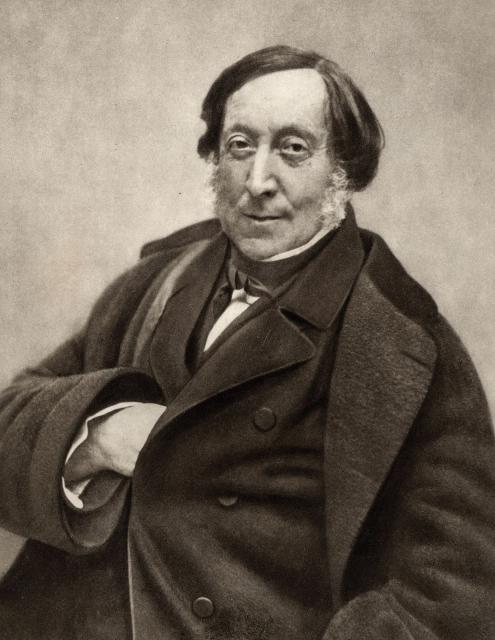
Joakkino Rossini
 Italy
ItalyBiography of Gioachino Rossini
Gioachino Rossini, an Italian composer, was born on February 29, 1792, in the city of Pesaro, Italy. He was born into a family of a town trumpeter and a singer. Rossini developed a love for music, particularly singing, at a very young age, but he didn't start taking it seriously until he was 14 years old when he enrolled in the Bologna Music Academy. There, he studied cello and counterpoint until 1810 when his first notable composition, the one-act opera buffa "La cambiale di matrimonio" (The Marriage Contract), was performed in Venice. This was followed by a series of operas of the same genre, including "La pietra del paragone" (The Touchstone) and "La scala di seta" (The Silken Ladder), which are still popular today.

In 1813, Rossini composed two operas that immortalized his name: "Tancredi" based on Tasso's poem and the two-act opera buffa "L'italiana in Algeri" (The Italian Girl in Algiers), which was triumphantly received in Venice and Northern Italy. Although he attempted to compose several operas for Milan and Venice, none of them, including the charming opera "Il Turco in Italia" (The Turk in Italy), achieved success similar to "L'italiana in Algeri". In 1815, Rossini had another stroke of luck in Naples, where he signed a contract with the impresario of the San Carlo Theater. It was during this time that he composed "Elisabetta, regina d'Inghilterra" (Elizabeth, Queen of England), a virtuosic work specifically written for Isabella Colbran, a Spanish prima donna and the impresario's mistress (she later became Rossini's wife).
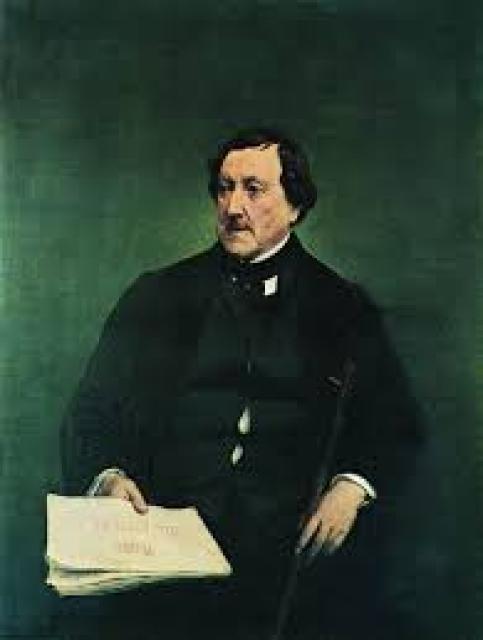
Rossini then traveled to Rome, where he planned to write and stage several operas. The second of these was "Il Barbiere di Siviglia" (The Barber of Seville), first performed on February 20, 1816. The opera's failure on its premiere was as notable as its future triumph. Returning to Naples according to the terms of his contract, Rossini staged an opera in December 1816 that was highly appreciated by his contemporaries: "Otello" based on Shakespeare. Although the opera had truly beautiful pieces, it was marred by a libretto that distorted Shakespeare's tragedy. Rossini's next opera, "La cenerentola" (Cinderella), was composed again for Rome. While it was later warmly received by the public, its premiere did not indicate its future success. However, Rossini took the failure much more calmly. In the same year, he traveled to Milan to stage "La gazza ladra" (The Thieving Magpie) – a melodrama with exquisite orchestration that is now almost forgotten, except for its magnificent overture. Upon his return to Naples, Rossini staged "Armida," an opera that was warmly received and is still highly regarded compared to "La gazza ladra." Over the next four years, Rossini managed to compose a dozen more operas, mostly of little interest. However, before his contract with Naples was terminated, he gifted the city with two outstanding works. In 1818, he wrote the opera oratorio "Mos in Egitto" (Moses in Egypt), which soon gained popularity across Europe, especially for its magnificent choruses and the famous "Prayer." In 1819, Rossini presented "La donna del lago" (The Lady of the Lake), which had a more modest success but contained charming romantic music.

After "Guillaume Tell" in 1829, Rossini did not compose any more operas and, for the next four decades, only created two significant compositions in other genres. This cessation of his musical activity at the height of his skill and fame remains a unique phenomenon in the history of world music. Numerous explanations were offered, but the full truth remains unknown. Some claimed that Rossini's departure was due to his disapproval of the new Parisian operatic idol, Giacomo Meyerbeer, while others pointed to the offense caused by the actions of the French government, which attempted to terminate his contract after the revolution in 1830. Some even mentioned a decline in the composer's health and his supposed incredible laziness. It is possible that all these factors played a role except for the last one. It should be noted that when leaving Paris after "Guillaume Tell," Rossini had a firm intention to start a new opera, "Faust." It is also known that he continued and won a six-year legal battle against the French government over his pension. Regarding his health, after the shock of his beloved mother's death in 1827, Rossini did experience discomfort, initially not very severe but later progressing rapidly. The rest are more or less plausible speculations.
During the decade following "Guillaume Tell," Rossini, although keeping an apartment in Paris, primarily lived in Bologna. He hoped to find the peace he needed after the nerve-wracking years. However, in 1831, he met Olympia Pelissier. His relationship with his wife had been unsatisfactory for a long time, and eventually, they decided to separate. Rossini married Olympia, who became a good wife for the ailing composer. In 1855, following a scandal in Bologna and disillusionment with Florence, Olympia convinced Rossini to hire a carriage (as he didn't believe in trains) and go to Paris. His physical and mental condition began to improve very slowly, and he regained some of his cheerfulness and wit. Music, which had been a forbidden topic for many years, started coming to his mind again. On April 15, 1857, Olympia's name day became a turning point of sorts. On that day, Rossini dedicated a cycle of romances to his wife, which he had composed in secret. This was followed by a series of small pieces Rossini called "Sins of My Old Age," and this music attracted the attention of musicians who used it as the basis for the ballet "La boutique fantasque" (The Magic Toyshop). Finally, in 1863, Rossini released his last truly significant work, the "Petite messe solennelle" (Little Solemn Mass). This mass, not very solemn and not at all small, is beautiful in its music and filled with deep sincerity, which drew the attention of musicians.
Rossini passed away on November 13, 1868, and was buried in the Père Lachaise Cemetery in Paris. Nineteen years later, at the request of the Italian government, his coffin was transported to Florence and buried in the Santa Croce church alongside the remains of Galileo, Michelangelo, Machiavelli, and other great Italians.



