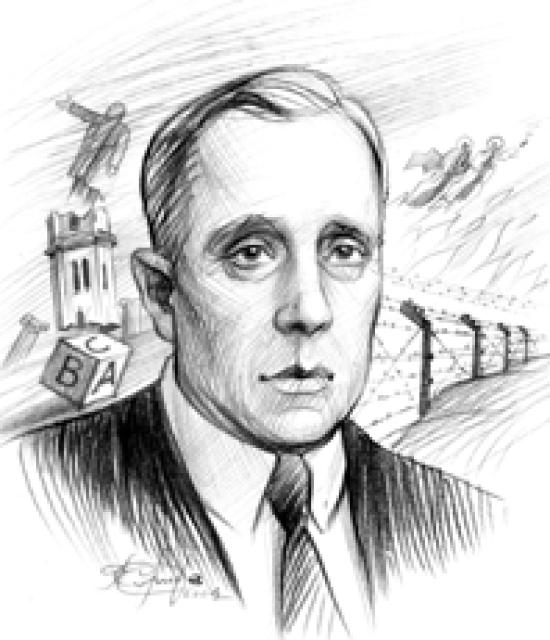
Johan Huizinga
 Netherlands
Biography of Johan Huizinga
Introduction
Johan Huizinga was a Dutch philosopher, historian, and cultural researcher, as well as a professor at the University of Groningen and Leiden University. He lived in the 20th century, a time marked by debates about history. During this period, history became a source of inspiration for Nazis and liberals, defenders of empires and fighters for the liberation of nations. For each of them, history was divided into a "correct" version that suited their agendas and another version that did not. There was also academic history, which meticulously collected facts, and fictional history, which delighted millions of readers and provided them with moral guidance, usually dependent on the author's own morals. However, in the small country of the Netherlands, a man named Johan Huizinga emerged who revolutionized all three types of history. Today, few people remember the surnames of the first Nobel laureates in literature. The first laureate, in 1901, was the nearly forgotten French poet Sully Prudhomme. The following year, in 1902, the prize was awarded to Theodor Mommsen, a pillar of German historical science and perhaps all of Europe, for his work "The History of Rome". Mommsen's work was a model of impeccability, devoid of any emotionalism, with meticulously verified facts, and a critical perspective on any dubious accounts by contemporaries. This work was a triumph of balance and impartiality. However, the following year, after receiving the Nobel Prize, Mommsen passed away, and perhaps with him, in the 19th century, the belief that "History is fact" was lost. No, the 20th century responded, "History is interpretation." And it posed the question: "Where are its boundaries?" After all, facts are based on sources. But a historical source is nothing more than an incomplete trace of what happened in the past. Therefore, in reality, history deals not with facts, but with their incomplete traces. This, in turn, implies that objectivity, in the spirit of Mommsen, is just one interpretation. Other interpretations are also possible. In other words, if we refuse to strictly adhere (albeit critically) to the chronicles of the past, then we must give ourselves freedom. But in doing so, we must also follow the "law of honesty," which requires historians not to assert any propositions that cannot be verified. Thus, the first condition is formulated - intellectual honesty. However, even that is not enough. No one can escape from themselves, from their own world. The historian's personality leaves an imprint on what they write. Arnold J. Toynbee, a lone figure standing apart from everyone else, the inventor of the history of civilization as the history of humanity, was not just a devout Christian. For him, Christ the Savior was the only truly noteworthy figure in all of human history. Toynbee's civilizational history, as expounded in his multivolume "A Study of History," regardless of the subject of analysis - the Islamic region or the Far East, the Mayan civilization or the unrealized Northern Christian civilization - was united by one idea: Christ is the only one who deserves each individual to study under him.
Early Life and Education
Johan Huizinga was born in 1872 in the small town of Groningen, located in the north of the Netherlands. Several generations of his ancestors were Protestant Mennonite ministers. However, as the renowned Russian Christian thinker S.L. Averintsev, who introduced Huizinga to Russia, wrote: "In the course of Huizinga's spiritual development, this inherited Christianity underwent a strong secularization, losing all confessional traits and becoming an addition (and a corrective) to the tradition of classical humanism."
From the very beginning of his life, Huizinga was an avid humanist, uninterested in what is commonly referred to as exact or natural sciences. Although his father (biographers of Huizinga somehow persistently emphasize the fact that he suffered from acquired syphilis) was engaged in chemistry and biology. In high school, Huizinga became interested in Semitic languages, such as Hebrew and Arabic. Those who knew him noted that he always worked without haste and fuss, focusing only on what interested him for its own sake. In his autobiography, "My Path as a Historian," he stated that he was not a diligent reader.
One of his favorite pastimes was solitary walks, during which he enjoyed deep contemplation. He valued his thoughts and tried to simply understand what was floating in the air.
The Netherlands at the end of the 19th century was a relatively poor country. The remaining overseas colonies did not bring in any significant income to the crumbling empire. The land was barren, and the way of life during those years was captured in Vincent van Gogh's "The Potato Eaters." Huizinga's family did not have enough money to send him to Leiden University, where he could continue studying Semitic languages. Instead, he had to settle for the University of Groningen, where he pursued a degree in Dutch philology. Interestingly, this philology program included the study of Sanskrit.
While studying in Groningen, Huizinga became deeply interested in history, especially in the late Middle Ages. He discovered a new way to understand history, not as a prophecy of the future but as the fading away of the past. History began with republican Rome and was now retreating into the past. Repeating what he wrote is entirely pointless. Simply reading his text is pure pleasure. For the first time, readers could understand the feelings and thoughts of people from long-gone eras. These individuals were disappearing into the past. This understanding later became the basis for the concept of "mentality" as a connection between time and space in the perception of an individual, as well as the codes and signs of this connection.
After completing his studies in Groningen, Huizinga continued his education in Leipzig, where he studied Slavic languages, as well as Lithuanian and Old Irish. Once again, from an average person's perspective, these pursuits seemed empty. His dissertation was titled "On the Vidushaka in Indian Drama," for which he had to read most of the ancient Indian plays in Sanskrit. In his work, Huizinga demonstrated the profound differences between Eastern and European understandings of humor.
After defending his dissertation, he struggled to find work in his field and had to become a regular high school history teacher in Haarlem. It was only when he began teaching history that he truly immersed himself in it. "I did not worry about the critical foundation. I just wanted to give a lively narrative," he recalled. He brought this liveliness to his writings as well. It was not fictionalized, but simply a joy to read. Academic historians were always skeptical of him. "A splendid thing," one of them said about "The Autumn of the Middle Ages," "just don't think it resembles history." Another historian noted that Huizinga "always lacked a solid methodological foundation." However, after the world became acquainted with Huizinga's work, history as the analysis of mentality became a methodology in itself. This is a fact.
Perhaps there was something special about him because when a position opened up at the history department in Groningen, he submitted his application, despite the resistance from the university community. However, based on the insistence of his mentor, he was accepted without having published a single work on history. Teaching history at Groningen University from 1904 to 1915, he hardly published anything. From the perspective of classical university traditions, this was almost nonsensical. However, he successfully married the daughter of a reputable citizen of Groningen, who also held a high position in local government.
Huizinga later admitted that during these years, he experienced a rupture with the East in his consciousness and a closer connection with European history, particularly the late Middle Ages. He recalled that during one of his walks, an idea struck him: the late Middle Ages was not a harbinger of the future, but rather the death throes of a bygone era. History, which had started with republican Rome, was retreating into the past. There is no point in summarizing what he wrote; it is simply meaningless. Reading his text is a pure pleasure. For the first time, readers could understand the feelings and thoughts of people from long-gone eras. These individuals were disappearing into the past. Later, this understanding became the basis for the concept of "mentality" - the connection between time and space in the perception of an individual, as well as the codes and signs of this connection.
During this period, he remarried. Huizinga's intellectual status in Europe was exceptionally high, although primarily within narrow circles. Nevertheless, he was considered one of the intellectual and moral leaders in his country. In Europe and America, his ideas spread like wildfire. However, too many people not only failed to credit Huizinga as the source of their exercises but also sought to criticize him as a brilliant but unprofessional scholar. Nonetheless, he did not take offense and did not respond to the accusations.
The outbreak of World War II led to an interesting situation in Dutch history. The country was occupied almost without resistance. However, Hitler strangely had his own respect for the Dutch. He even said that if Germans possessed the qualities of the Dutch, they would be invincible. He likely had in mind the remarkable resilience of the inhabitants of the "lowlands." However, on the eve of the war, the nation was essentially unified. For example, there was a growing movement to abolish the monarchy.
Exiled Queen Wilhelmina, having taken refuge in England, assumed the role of unifying the Dutch people. Almost daily, she addressed her compatriots on the radio, urging them not to surrender and to maintain their pride. For the Dutch, the "Grandmother" became a symbol of resilience, much like De Gaulle for the French or Churchill for the British. After the war, Wilhelmina, and later her successors - Juliana and Beatrix - became agents of national consolidation.
There were, of course, collaborationists. Dutch citizens even served in SS units. However, the resistance continued. Huizinga did not participate in the resistance but remained a humanist who refused to compromise his principles. He was such a figure for all anti-Nazis. In the end, Leiden University, where Huizinga was serving as rector since 1932, was closed, and he found himself in an internment camp as a hostage. The Nazis knew whom to take, but they did not truly know him. He remained a historian. On October 3, 1942, he delivered a lecture to his fellow internees. This lecture took place on the anniversary of the lifting of the Spanish siege of Leiden in 1574. He spoke about freedom, courage, and resilience. Ultimately, he emphasized kindness and wisdom. This was his mentality. This was his culture.
German scholars, as well as the remaining European humanists of occupied Europe, were not afraid to acknowledge him as one of their own. However, many did not cite Huizinga as the source of their exercises; rather, they sought to criticize him as a brilliant but non-professional scholar. He did not take offense and did not respond to these accusations.