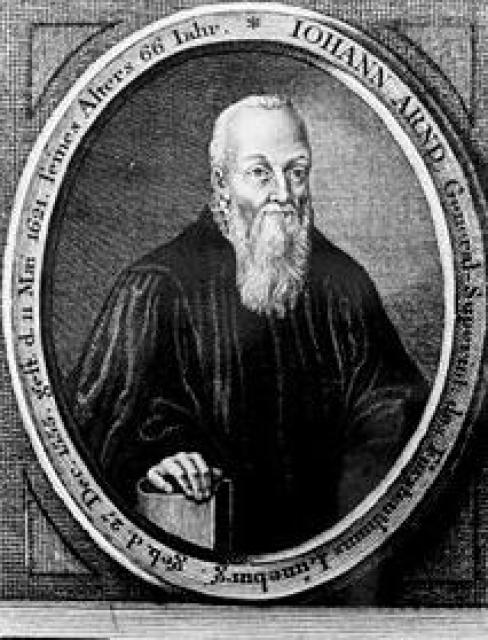
Johann Arndt
 Germany
- Johann Arndt: Early Life and Influences
- Ministerial Journey and Disagreements
- Influential Works: "On True Christianity"
- Mystic and Controversial Figure
- Later Years and Legacy
Johann Arndt: Early Life and Influences
Johann Arndt, a pioneering German Lutheran theologian and religious writer, was born on December 27, 1555, in Ballenstedt, Anhalt, to a Lutheran pastor father. Tragically, he became orphaned at a young age.
Arndt pursued a wide-ranging education, studying medicine, theology, the humanities, and natural sciences. He immersed himself in the writings of medieval mystics, such as Bernard of Clairvaux, Johann Tauler, Thomas à Kempis, and the anonymous Theologia Teutsch.
Ministerial Journey and Disagreements
In 1583, Arndt became a pastor in Badeborn. However, he resigned seven years later due to his differing views on sacraments from the prevalent Calvinist doctrine. He then resided in Quedlinburg from 1590 to 1599 before accepting a pastoral position in Brunswick.
Influential Works: "On True Christianity"
In Brunswick, Arndt's pastoral ministry flourished, and he published the first part of his seminal work, "On True Christianity" (Vom wahren Christentum), in 1605. Derived from his sermons, this book profoundly influenced Protestantism.
Arndt's keen interest in theology extended to alchemy, natural history, and medicine. He incorporated his knowledge into both "On True Christianity" and his devotional book, "Garden of Eden" (Paradiesgärtlein).
Mystic and Controversial Figure
Arndt's fusion of Lutheran orthodoxy with mysticism in his concept of true Christianity sparked theological debates. He believed that genuine faith integrated faith, life, justification, and sanctification. This idea placed him at the center of theological controversies during his time.
Later Years and Legacy
In 1611, Arndt relocated to Eisleben, where he published the remaining four parts of "On True Christianity" (1609). He continued to write and advocate for his beliefs until his passing in Celle, Hanover, on May 11, 1621.
Arndt's writings, translated into various European languages, distinguished themselves with their accessible, poetic, and heartfelt language. His legacy as a key figure in Protestantism remains strong today.