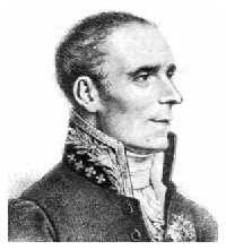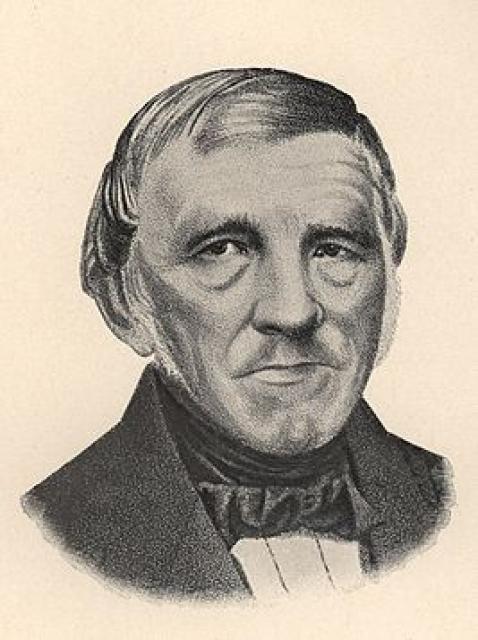
Johann Franz Encke
 Germany
Biography of Johann Franz Encke
Johann Franz Encke (1791–1865) was a German astronomer known for his work on determining solar parallax. He was born on September 23, 1791, in Hamburg. Encke studied at the University of Göttingen under the guidance of Carl Friedrich Gauss.
Early Career
From 1816 to 1825, Encke worked as an astronomer at the Gotha Observatory. In 1825, he became the director of the Berlin Observatory, a position he held for almost 40 years.
Determination of Solar Parallax
Encke is renowned for his research on determining solar parallax, which involved observing the transit of Venus across the face of the Sun from different locations on Earth. This method was originally proposed by Edmond Halley. By analyzing data from the transits of Venus in 1761 and 1769, Encke calculated the solar parallax and used this information to refine the distance between the Sun and Earth.
Encke's Comet
Encke's research on comets, specifically the comet now named after him, was also of significant importance. In 1819, he established that comets previously discovered by Pierre Méchain, William Herschel, and Jean-Louis Pons were actually the same short-period comet with an orbital period of 3.3 years. Encke analyzed the comet's motion over an extended period, taking into account perturbations caused by the six planets, and developed a new method for calculating perturbations in a rectangular coordinate system, known as the Encke method.
Legacy
Johann Franz Encke passed away on August 26, 1865, in Spandau. His contributions to the field of astronomy, particularly his work on solar parallax and comets, have left a lasting legacy in the scientific community. His methods and research continue to be studied and utilized by astronomers today.