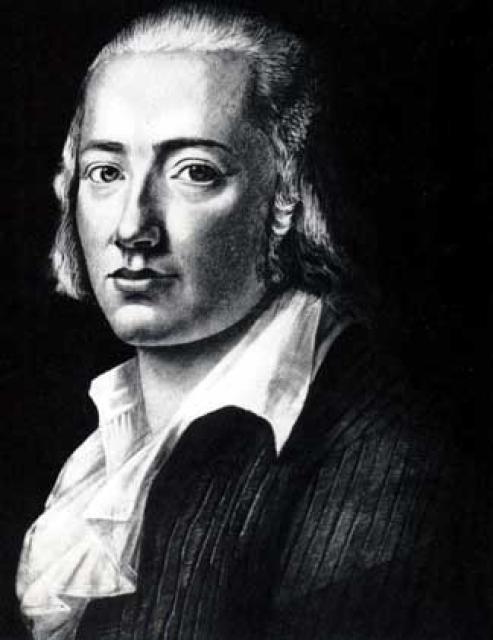
Johann Hlderlin
 Germany
Biography of Johann Gottlieb Fichte
Johann Gottlieb Fichte was a German philosopher born on 20 March 1770 in Lauffen-on-Neckar. Although his parents had envisioned a career for him as a Protestant priest, his education in school and university ignited a deep interest in the world of Hellenic antiquity and philosophy, which brought him closer to his university companions - G.W.F. Hegel and F.W.J. Schelling. After completing his studies at the theological faculty in Tübingen (1793), Fichte became a private tutor near Jena. However, before settling into the society of Weimar and Jena, Fichte was called back home and reluctantly accepted another position as a private tutor, this time in Frankfurt-on-Main (December 1795). The mother of his students there would be celebrated by Fichte under the name Diotima. Enthralled by the works of Plato, Pindar, and Sophocles, Fichte soon revealed himself as a master of the ancient forms of lyric poetry. However, the idyllic time in Frankfurt abruptly ended in the autumn of 1798. Fichte's despair over the separation and memories of past happiness found expression in the remarkable elegy "Menon's Lament for Diotima" (Menons Klage um Diotima). Written in rhymed elegiac distichs, it affirms the belief that personal sorrow will inevitably transform into a higher, all-encompassing harmony. This same faith breathes through Fichte's lyrical novel "Hyperion, or The Hermit in Greece" (Hyperion oder Der Hermit in Griechenland, Vol. 1-2, 1797-1799).
Works and Later Life
Even before leaving Frankfurt, Fichte began working on "The Death of Empedocles" (Der Tod des Empedokles, 1797-1800), a religious tragedy in the spirit of Sophocles. However, this ambitious project remained unfinished as Fichte struggled to support himself and had to seek positions as a private tutor. In December 1801, he left for Bordeaux, and in June 1802, he returned to Stuttgart, where he experienced a mental illness. The most significant works from this period - "The Rhine" (Der Rhein), "Germany" (Germanien), and "Patmos" (Patmos) - prophesied about the future. Among Fichte's last works were also inspired translations of "Antigone," "Oedipus Rex," and several hymns by Pindar. After forty years of madness, Fichte, one of the greatest poets of German Romanticism, died in Tübingen on 7 June 1843.


