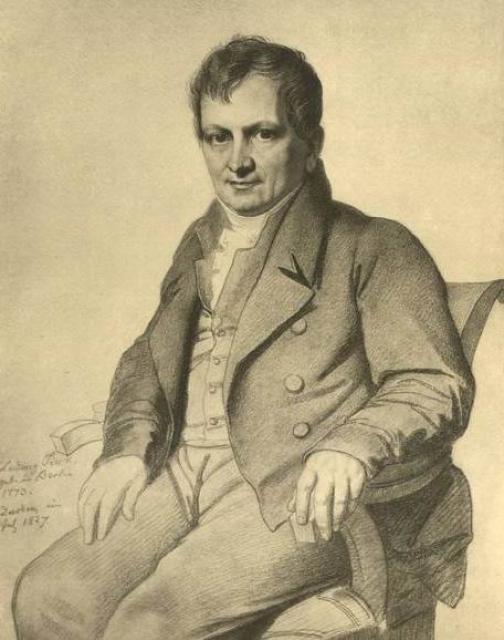
Johann Ludwig Tieck
 Germany
Biography of Johann Ludwig Tieck
Johann Ludwig Tieck was a German poet, writer, and critic. He was born on May 31, 1773, in Berlin, into a family of a rope master. He studied at the universities of Halle, Göttingen, and Erlangen, with a special focus on the history of English literature, particularly the Elizabethan era (16th century).
In 1794, Tieck began his collaboration with the Berlin publisher and writer-enlightener, Karl Friedrich Nicolai (1733–1811). At Nicolai's request, Tieck continued the prose cycle "Straussfeathers" (Straussfedern, 1787) by I.K. Musäus (1735–1787), complementing it with satirical and didactic-rationalistic novellas (1795–1798). These works sharply contrasted his earlier exotic and highly original works, such as "Almansur" (1790). The blending of rationalism and romanticism is characteristic of Tieck's entire body of work.
Tieck's major works include the epistolary novel "The Story of Herr William Lovell" (Die Geschichte des Herrn William Lovell, 1795–1796) and "Folk Tales of Peter Lebrecht" (Volksmärchen, herausgegeben von Peter Lebrecht, 1797). The latter includes both retellings of legends and folklore from the 15th and 16th centuries, as well as Tieck's own incredibly original tales, filled with enchantment and mystery, such as "The Fair-Haired Eckbert" (Der blonde Eckbert). The Folk Tales caught the attention of the Schlegel brothers, particularly August Wilhelm, who declared Tieck a "romantic" poet.
In 1799, Tieck started working on his "Romantic Works" (Romantische Werke, 1799–1800), which included the typical romantic drama "The Life and Death of Saint Genevieve" (Leben und Tod der heiligen Genoveva). In 1804, he published the massive and weighty play "Emperor Octavian" (Kaiser Octavianus), which he considered the best example of his "romantic manner."
In 1802, Tieck settled near Frankfurt-on-the-Oder, in Ziebingen, in the estate of Count C. Finckenstein, where he remained until 1819, with occasional trips such as his visit to England in 1817. During this time, he created adaptations of medieval German poetry ("Songs of Love from the Swabian Era" – Minnelieder aus dem schwäbischen Zeitalter, 1803), prepared collections of Elizabethan plays ("Old English Theater" – Altenglisches Theater, 1811), and German drama from the 16th and 17th centuries ("German Theater" – Deutsches Theater, 1817).
In 1819, Tieck moved with his family to Dresden, where he served as the director of the literary department of the court theater from 1825 to 1830. During these years, he distanced himself from Romanticism and wrote a series of novellas in which realistic plots often served as moralizers on social and literary themes. Tieck's last significant work was the novel "Vittoria Accorombona" (1840), set in the era of the Italian Renaissance. He also wrote numerous articles, many of which did not leave a lasting impact, and edited translations of Shakespeare's plays done by Count W. Baudissin (1784–1878) and Tieck's daughter Dorothea.
In 1842, Tieck relocated to Berlin at the invitation of King Frederick William IV of Prussia, where he directed productions of classical and Elizabethan dramas. His works from 1820 to 1840 had a significant influence on English and American literature. Tieck passed away on April 28, 1853, in Berlin.