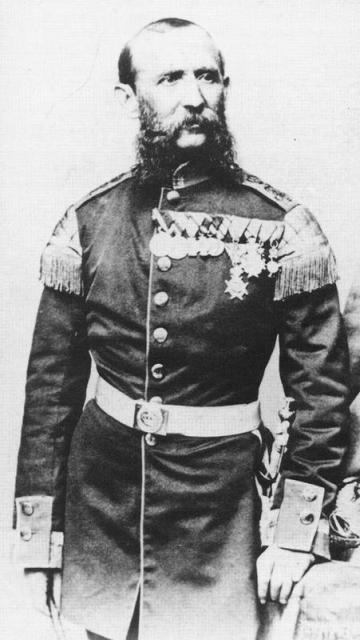
Johann Pifke
 Germany
- Prussian Military Composer and Conductor
- Return to Military and Musical Recognition
- Military Campaigns and the "Pifke" Nickname
- Post-War Career and Death
- Military Marches and Legacy
- Decorations and Awards
Prussian Military Composer and Conductor
Early Life and Military ServiceWilhelm Wieprecht (known as Wilhelm Pifke) was born in 1815 to Johann and Dorothea Wieprecht. His father was an organist. On May 1, 1835, Pifke joined the military as an oboist in the Leib-Grenadier Brigade Nr. 8 in Frankfurt-on-Oder. In 1838, he enrolled in the prestigious music academy in Berlin, where he received patronage from Countess von Trachtenberg.
Return to Military and Musical Recognition
In 1843, Pifke returned to his unit as senior oboist. In 1852, he rejoined the Berlin musical scene and gained recognition as a musician. On June 23, 1859, he was bestowed the title of Royal Director of Music. Six years later, King William I of Prussia appointed him Director of the Music Chorus of the III Army Corps.
Military Campaigns and the "Pifke" Nickname
In 1860, Pifke was recalled to Frankfurt. During the German-Danish War in 1864, he participated in the Battle of Dybbøl, where he signaled the attack. After the Prussian-Austrian War in 1866, he led a massive victory parade in Vienna, along with his equally tall brother, Rudolf. The grandeur of their appearance led to the Viennese dubbing northerners "Pifkes," a nickname that later became derogatory.
Post-War Career and Death
Pifke fell ill during the Franco-Prussian War of 1870-1871 but returned to his unit. After the conflict, he pursued classical music, organizing concerts in Frankfurt. He passed away on January 25, 1884, and was buried with military honors, but his gravesite has been lost.
Military Marches and Legacy
In addition to his military career, Pifke composed and arranged classical music. However, he is primarily remembered for his numerous military marches, including "Prussian Glory," the "March of the Battle of Dybbøl," and the "Königgrätzer March."
Decorations and Awards
- Cross for the Assault of Düppel, 1864- Golden Medal of the Kaiser of Austria-Hungary, 1865
- Order of the Royal House of Hohenzollern, January 18, 1869
- Iron Cross, 2nd Class, 1871
- Order of the Prussian Crown, 4th Class, 1880


