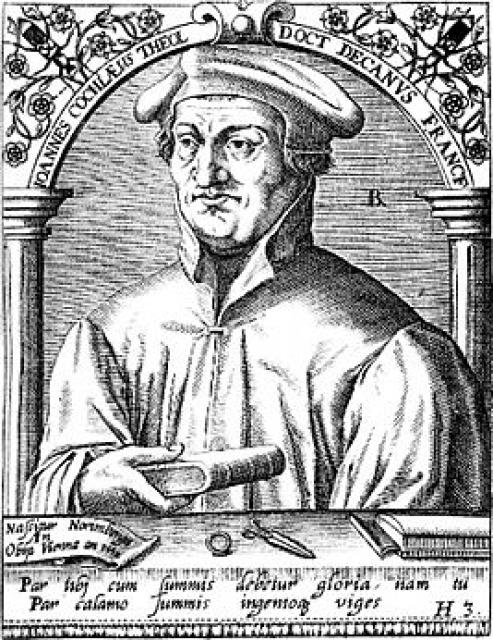
Johannes Cochlaeus
 Germany
- Johann Cochlaeus: German Humanist and Theological Polemicist
- Early Life and Education
- Opposition to Luther
- Historical Writings
- Treatise on the Hussites
- Later Years and Legacy
Johann Cochlaeus: German Humanist and Theological Polemicist
Johann Cochlaeus, born on January 10, 1479, in Wendelstein, Franconia, was a prominent German humanist, Catholic theologian, and music theorist of the 16th century.
Early Life and Education
Born with the surname Dobenek, Cochlaeus adopted the Latinized form of his name, which means "snail." He pursued his studies in theology at the University of Ferrara, Italy, and traveled extensively throughout the country.
Opposition to Luther
Cochlaeus became a staunch opponent of the Protestant Reformation led by Martin Luther. He engaged in theological disputes with Luther and published numerous polemical works against him. His writings played a significant role in the religious controversies of the time, comparable to that of the famous humanist Johann Eck.
Historical Writings
Cochlaeus's writings, however, are known for their subjective and biased nature, making them unreliable sources for understanding the historical events of the 16th century. His major work, "Commentarii de actis et scriptis Lutheri" (1549), chronicles Luther's life and writings from a strongly anti-Lutheran perspective.
Treatise on the Hussites
Cochlaeus also authored "Historiae Hussitarum libri XII" (1549), a historical account of the Hussite movement in Bohemia. This work provides insights into the religious and political conflicts that characterized the era.
Later Years and Legacy
Cochlaeus continued to write and engage in religious debates until his death on March 10, 1552, in Breslau (present-day Wrocław, Poland). His writings had a profound impact on the religious and intellectual landscape of the 16th century, shaping the perception of the Protestant Reformation and its key figures.


