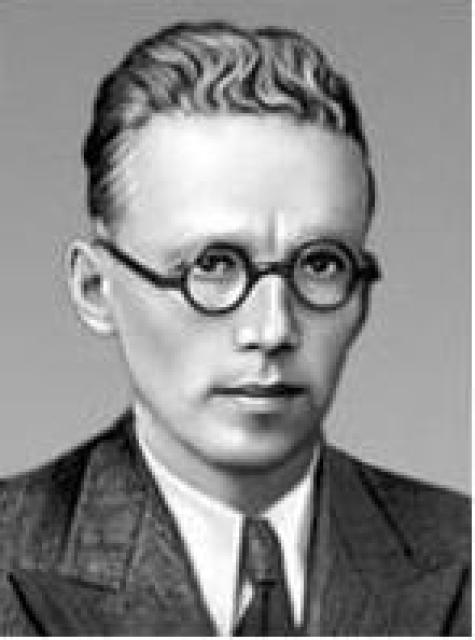
Johannes Lauristin
- Childhood and Education
- Early Revolutionary Activity
- Service in the Estonian Army and Communist Underground
- Rise in the Communist Party
- Literary Career
- Role in the Establishment of the Estonian SSR
- Chairman of the Council of People's Commissars
- World War II and Death
- Legacy
Childhood and Education
Johannes Lauristin (also known as Johan) was born on (October 29) November 10, 1899, in Reval (present-day Tallinn), Estonia. His father worked at the Dvigatel factory. Lauristin's childhood and school years were spent in the Reval district of Estonia, where he lived in the village of Kuiväe and later on the Tuisu farm. He graduated from school in 1914.
Early Revolutionary Activity
In 1915, Lauristin returned to Reval and began working at the Volta factory. A year later, he joined the Dvigatel factory, where he worked for nearly two years. His political activities began during this time at the factory. In May 1917, he became a member of the Communist Party and began conducting revolutionary propaganda among the factory workers.
Service in the Estonian Army and Communist Underground
From 1919 to 1921, Lauristin served in the Estonian army. Upon his return from the army, he became a member of the organizational committee of the illegal Communist Youth Union of Estonia (KSME). This organization was established in the summer of 1921 after the government closed the All-Estonian Union of Young Proletarians. The KSME published an illegal newspaper, "Noor Proletaarne" ("Young Proletarian"), and established its own underground organizations in numerous enterprises.
Rise in the Communist Party
In 1922, Lauristin became a member of the Central Committee of the Communist Youth Union of Estonia. After the establishment of the Central Council of Trade Unions of Estonia in August 1922, he joined its ranks. At the 2nd Congress of Labor Unions, held from November 27-29, he delivered a presentation on "Strengthening and Expanding the United Front of Workers." During the same congress, Lauristin was elected Deputy Chairman of the Central Council of Labor Unions. The "Workers' Basement" became the legal headquarters of the Union, where Lauristin actively participated in meetings and organized labor organizations and conferences.
Literary Career
Johannes Lauristin began his literary career with early publications in 1922, using the pseudonym "Juhan Madarik." While in prison from 1925 to 1927, he wrote the novel "Nisuvergjad" ("Overthrowers"). In this work, he created the character of Alexander Marble, a revolutionary. The novel was published in Leningrad in 1929 with a foreword by Jaan Anvelt and achieved great success.
Role in the Establishment of the Estonian SSR
In 1940, Johannes Lauristin played a significant role in the events leading to the establishment of the Estonian SSR. He became one of the leaders of the Information Center of the new government. As an elected deputy to the 2nd State Duma, he delivered a report on "Estonian State Organization" during the parliament's first session. Lauristin was also among those who supported Estonia's entry into the USSR and the nationalization of land.
Chairman of the Council of People's Commissars
On August 24, after the Estonian SSR was accepted into the Soviet Union, Lauristin presented a draft Constitution for the Estonian SSR to the State Duma. The Constitution was adopted based on his report. On the same day, a decree was passed, transforming the State Duma into the Supreme Soviet of the Estonian SSR, and Lauristin was appointed Chairman of the Council of People's Commissars of the ESSR.
World War II and Death
On June 22, 1941, World War II began. On August 28, the destroyer "Volodarsky" carrying Lauristin was reportedly blown up by a mine during an evacuation from Tallinn. According to the official version, Lauristin perished in this incident.
Legacy
Johannes Lauristin's literary works, particularly his novel "Republic," provide insights into the social and political struggles in Estonia. His political contributions, especially his role in the establishment of the Estonian SSR, left a lasting impact on the nation's history. His wife, Olga Lauristin, was also a prominent revolutionary and politician, and their daughter, Marju Lauristin, became a renowned sociologist and politician in independent Estonia.


