Johannes Popits
 Germany
- Childhood and Education
- Early Career and Rise in Public Service
- Service Under the Nazi Regime
- Opposition and the July 20 Conspiracy
- Legacy and Historical Significance
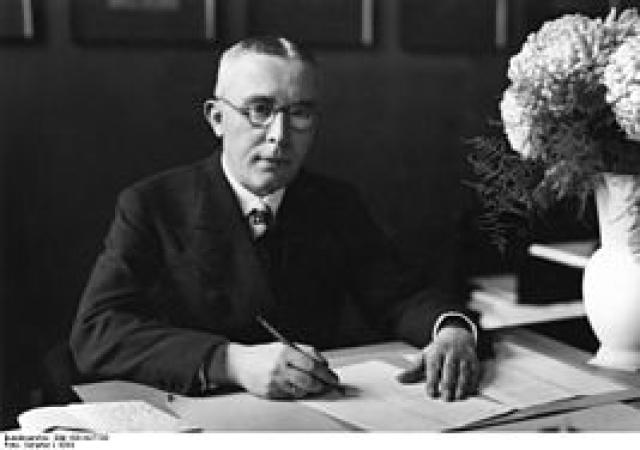
Hermann Eduard Johannes Popitz rose through the machinery of German government as a gifted lawyer and fiscal expert, then became one of the most paradoxical figures in the resistance to Hitler. He held high office under the Nazi regime, helped shape its administration, and for years believed an authoritarian state could restore Germany. Yet he ultimately joined efforts to overthrow Hitler, carrying conservative plans for a post-Nazi government that were as far from democracy as they were from Nazi rule.
Childhood and Education
Popitz was born in Leipzig on December 2, 1884, the son of pharmacist Heinrich Popitz and Anna Rudolph. He received a classical education and studied law and political science in Dessau, Lausanne, Leipzig, Berlin, and Halle. In 1907 he completed a doctorate with a dissertation on political parties in Prussian administrative law. The subject pointed toward the combination that defined his career: legal precision, administrative power, and an abiding interest in how the state should be organized.
Early Career and Rise in Public Service
After legal training in Cologne and Beuthen, Popitz worked at Berlin’s Higher Administrative Court and in the Prussian Interior Ministry. From 1916 he also served in the Imperial Treasury, moving into the new Reich Finance Ministry after Germany’s defeat in the First World War. He became a senior official in 1919, a ministerial director in 1921, and a professor of tax law and public finance at the University of Berlin from 1922.
The postwar republic faced inflation, fiscal upheaval, and disputes over how money and authority should be divided between the national government and the states. Popitz became a leading specialist in this terrain. He contributed to the financial reforms of 1924–25 and in 1925 became state secretary in the Reich Finance Ministry, working under finance minister Rudolf Hilferding on tax and budget reforms. He also led the Society for Ancient Culture, reflecting his scholarly interest in classical art, culture, and philosophy.
In 1929, Popitz and Hilferding protested Reichsbank president Hjalmar Schacht’s influence over fiscal policy and the government’s handling of international financial negotiations. Both were placed into temporary retirement that December. Popitz returned to academic work, but his departure from the ministry was not the end of his political career.
Service Under the Nazi Regime
In 1932, Popitz returned to government as a Reich minister without portfolio and acting head of Prussia’s finance ministry. He saw himself as a monarchist and national conservative, favoring a strong central authority within a decentralized state. When the Nazis consolidated power, they appointed him Prussian finance minister on April 21, 1933. He was not an elected politician and was not a member of the Nazi Party according to the German Historical Museum; the same museum records that the party awarded him its Golden Party Badge in 1937.
Popitz’s service in the regime remains central to any account of him. The museum records that he initially served Hitler’s government in the belief that an authoritarian leadership could bring national renewal. He stayed in office as persecution intensified. After the anti-Jewish pogrom of November 1938, he submitted a resignation request in protest at the escalating persecution of Jews, but it was rejected. That protest did not erase his earlier collaboration or his continued tenure in a senior state position.
Opposition and the July 20 Conspiracy
From 1938, Popitz increasingly established contacts with opponents of Hitler, including members of the conservative Wednesday Society and military opposition circles. He worked with Hans Oster and became close to Carl Friedrich Goerdeler and Ludwig Beck. The shift did not make him a democratic reformer: Popitz drafted a provisional constitutional law for a future government that was strongly conservative and authoritarian, and he favored restoring the monarchy.
His position was unusually complicated even among conspirators. In 1943, he secretly met Heinrich Himmler, hoping to persuade him to break with Hitler and pursue peace negotiations with the Western powers. The maneuver failed to secure a decisive ally and made Popitz controversial among resistance members, who distrusted his dealings with senior Nazi leaders. He was nonetheless designated to serve as finance and cultural minister if the planned coup succeeded.
After Claus von Stauffenberg’s bomb attack on Hitler failed on July 20, 1944, the Gestapo arrested Popitz the following day. The People’s Court, presided over by Roland Freisler, sentenced him to death on October 3. During imprisonment he wrote an account of his life. On February 2, 1945, he was hanged at Plötzensee Prison in Berlin.
Legacy and Historical Significance
Popitz’s life resists a simple label. He was a respected public-finance scholar and senior administrator who remained in office under a dictatorship, while also becoming part of the conspiracy to remove its leader. His opposition grew from conservative convictions and a desire to replace Hitler’s system with a centralized, authoritarian order, rather than from a commitment to parliamentary democracy. That tension makes his story a reminder that resistance to Nazism included people with sharply different political goals, and that opposing Hitler did not automatically mean rejecting authoritarian government.