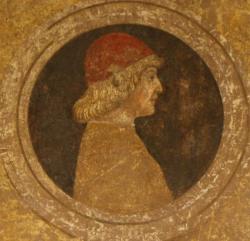
Johannes Scott Eriugena
 Ireland
- John Scotus Eriugena: A Carolingian Renaissance Scholar
- Early Life and Influence from Greek Philosophy
- Theological Controversies and Courtly Life
- Oxford and Martyrdom
- Neoplatonic Synthesis in "On the Division of Nature"
- Translation and Commentary
- Homily on the Fourth Gospel
- Poetic Endeavors
John Scotus Eriugena: A Carolingian Renaissance Scholar
John Scotus Eriugena, known for his profound philosophical and theological writings, emerged as a prominent figure during the Carolingian Renaissance. His dual surnames, "Scot" and "Eriugena," signify his Irish heritage: "Scot" referring to Gaelic people, and "Eriugena" meaning "from the land of winter" (Hibernia).
Early Life and Influence from Greek Philosophy
Growing up in Ireland, Eriugena gained fluency in Greek and delved into classical and Byzantine philosophy. His exposure to Greek thinkers, particularly Neoplatonists like Proclus, shaped his intellectual development.
Theological Controversies and Courtly Life
Eriugena's theological debate with Hincmar, Archbishop of Reims, led to the composition of his seminal work, "On Divine Predestination." This treatise drew objections from ecclesiastical authorities in Paris. Despite these controversies, Eriugena's reputation earned him an invitation to the court of Charles II the Bald, where he served as a leading scholar in the court school.
Oxford and Martyrdom
Later, Eriugena traveled to England and joined the theological school in Oxford, but his unconventional views clashed with local orthodoxy. He eventually became abbot of Malmesbury Abbey. According to legend recorded by historian William of Malmesbury, Eriugena met a gruesome end in England, stabbed to death by students using their writing styli.
Neoplatonic Synthesis in "On the Division of Nature"
Eriugena's magnum opus, "On the Division of Nature," is a five-volume treatise that synthesizes Latin and Greek Neoplatonic thought. It incorporates poetic and allegorical elements, reflecting his literary and rhetorical skills.
Translation and Commentary
As a scholar, Eriugena made significant contributions by translating the works of Pseudo-Dionysius the Areopagite, Maximus the Confessor, and Gregory of Nyssa into Latin. He also provided valuable commentaries on Martianus Capella's "On the Marriage of Philology and Mercury," Priscian's "Grammar," and other classical texts.
Homily on the Fourth Gospel
Eriugena's homily on the prologue to the Gospel of John, composed between 870 and 871, became immensely popular and was often attributed to Origen. It combines theological insights with художе prose, demonstrating Eriugena's multifaceted abilities.
Poetic Endeavors
Eriugena's poetry, with approximately 40 pieces extant, often features references to Pseudo-Dionysius. His verses include lines written in Greek, as well as the use of individual Greek words in their original spelling or in Latin transliteration.