
Johannes XXIII
 Italy
Italy- Biography of Pope John XXIII
- Early Life and Career
- In 1953, Roncalli became a cardinal and the Patriarch of Venice.
- Legacy
Biography of Pope John XXIII
Pope John XXIII was the Bishop of Rome from 1958 until his death in 1963. He was a Vatican diplomat and served as papal nuncio (ambassador) to Bulgaria, Greece, Turkey, and France. Once he ascended to the papal throne, he advocated for peace and peaceful coexistence among nations with different social systems. He sought to modernize the Catholic Church in response to changing global conditions. In 1962, he convened the Second Vatican Council.
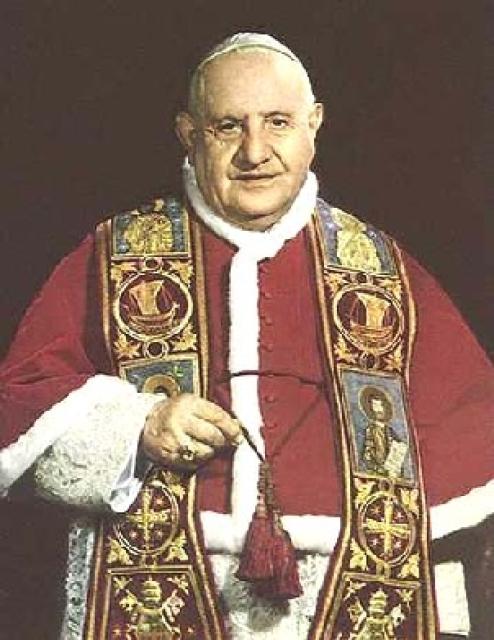
Early Life and Career
Angelo Giuseppe Roncalli was born in 1881 in Sotto il Monte, a small village in the province of Bergamo in northern Italy. Coming from a peasant family, he maintained a strong connection with his roots and his brothers who remained farmers. Roncalli completed his seminary studies in Bergamo in 1900 and studied theology at the Pontifical Roman Seminary in Rome, graduating in 1904. After receiving his theological degree and becoming a priest, Roncalli served as the secretary to the Bishop of Bergamo, Domenico Menini Radini-Tedeschi, for over a decade (1904-1914), while also teaching church history at the Bergamo Seminary.
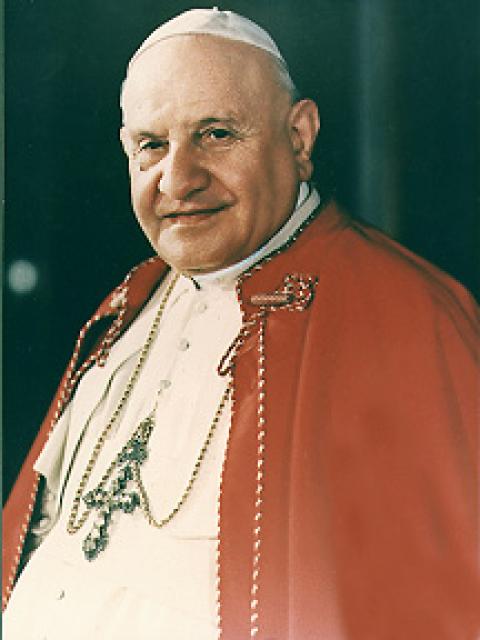
During World War I, Roncalli served in the army as a medic at a front-line hospital and later as a military chaplain. In 1921, Roncalli was appointed a member of the Sacred Congregation for the Propagation of the Faith. He was involved in the reorganization of missionary work and taught patrology at the Pontifical Lateran University in Rome. In 1925, Roncalli was appointed as the Apostolic Delegate to Bulgaria. His role was challenging as the Bulgarian king belonged to the Orthodox Church while his wife, from the House of Savoy, was Catholic. This led to conflicts regarding the religious upbringing of their children, which Roncalli had to navigate. In 1935, he became the Apostolic Delegate to Ankara, where he had to act simultaneously as a representative of the Holy See in Athens. Despite the difficult circumstances, Roncalli managed his responsibilities admirably, earning the trust of both French leaders and Soviet representatives.
In 1953, Roncalli became a cardinal and the Patriarch of Venice.
Papacy and ContributionsIn the autumn of 1958, Roncalli was elected as Pope and took the name John XXIII. His election was met with mixed reactions, as no pope had used the name John for nearly 550 years to avoid association with the controversial figure of Antipope John XXIII. However, Roncalli explained that the name held personal significance as it was his father's name.
Pope John XXIII's pontificate, which lasted less than five years, was characterized by a new direction in Vatican policy that aimed to address the changing realities of the world. He sought to establish dialogue among different countries and denominations, as well as improve the social conditions of believers worldwide. Many scholars consider his policies as an affirmation of the principles of Christian socialism, which were further developed in his encyclicals.
One of the major challenges faced by the Catholic Church was its confrontation with socialism. Unlike his predecessor, Pope Pius XII, John XXIII advocated strongly for peace and peaceful coexistence among nations with different social systems, regardless of the prevailing ideology. He urged world leaders to prioritize improving the well-being of all people, especially the poorest, rather than investing vast resources in preparing for war.
During his papacy, Pope John XXIII officially recognized the Cuban Revolution in 1959 and accredited a representative of the Cuban government at the Vatican in January 1962. However, the Vatican maintained its staunch opposition to communist ideology while attempting to establish diplomatic relations with socialist governments where millions of Catholics resided.
Alongside his efforts for peace and dialogue, Pope John XXIII also focused on the unity of the Christian world. He initiated contact with leaders of non-Catholic Christian churches and welcomed the Archbishop of Canterbury, Geoffrey Fisher, in Rome in 1960, marking the first meeting between a Pope and an Anglican leader in over 400 years.
His commitment to unity and dialogue led Pope John XXIII to convene the Second Vatican Council, also known as Vatican II. The council aimed to address the challenges of the modern world and promote ecumenism within the Christian community. The council's discussions included the renewal of church life, referred to as "aggiornamento," and the efforts to unite with other Christian denominations.
Legacy
Pope John XXIII's papacy, characterized by his pursuit of peace, dialogue, and social justice, left a lasting impact on the Catholic Church and the world. His commitment to social issues and reconciliation earned him the nickname "the Good Pope." Although he did not live to see the full implementation of the Vatican II reforms, his leadership set the stage for the church's modernization. Pope John XXIII's body was found to be miraculously preserved when exhumed in 2001, further solidifying his veneration within the Catholic Church. His feast day is observed on October 11th.


