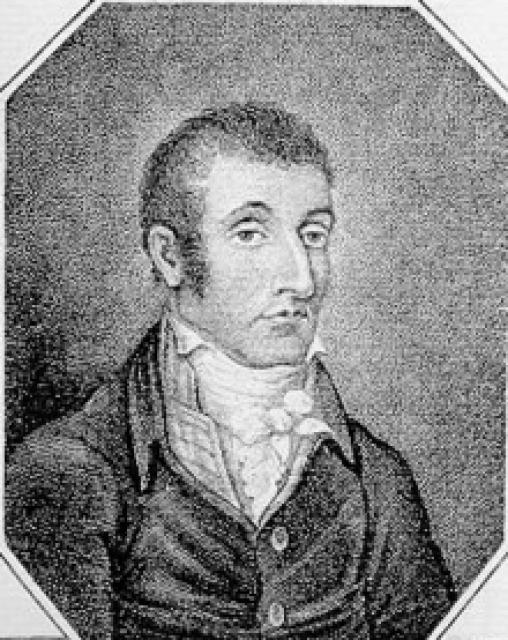
John Bellingham
 Great Britain
Biography of John Bellingham
John Bellingham was born in 1769 in St Neots, Huntingdonshire. Little is known about his early life, but at the age of 14, he went to study in London. Two years later, he joined the ship 'Hartwell' that sailed from Gravesend to China. In 1787, there was a mutiny on the ship, and it eventually sank. For the next few years, John's whereabouts were unknown.
In 1794, a certain John Bellingham opened a shop in London, which soon failed. It is speculated that this was the same John, but there is no concrete evidence. However, it is known that in the same period, John worked as a clerk in London. In 1800, he traveled to Arkhangelsk as a trade representative, and he returned two years later in 1802. In 1803, he got married, and during that time, John worked as a broker in Liverpool. In 1804, he went back to Arkhangelsk.
In the autumn of 1803, the Russian ship 'Soyuz' sank in the White Sea. The owners of the ship, the Van Brienen family, sought compensation from the insurance company 'Lloyd', but their claim was denied based on an anonymous letter alleging sabotage. Van Brienen suspected John Bellingham, who owned part of the ill-fated ship's cargo, as the author of the letter. Under Van Brienen's pressure, John had his passport confiscated while he was in Russia, and he was later arrested. This incident marked the beginning of a scandal that would greatly impact John Bellingham's life.
Desperate for help, John approached the British ambassador, but he was denied assistance. After a year in custody, he went to seek the truth in St. Petersburg, but this endeavor also ended in imprisonment. It wasn't until 1809 that John was released from prison, and after appealing to the Russian Emperor, he was allowed to leave Russia.
Upon his return to England, John was filled with anger and a thirst for revenge. He immediately petitioned the British government for compensation for his troubles in Russia, but he was once again denied. In utter despair, John personally approached the Prime Minister of Great Britain, Spencer Perceval, only to be rejected again. Wherever John turned for help and justice, he was met with deaf ears. He temporarily gave up his pursuit and began working.
In 1812, John resumed his attempts to seek justice and compensation, but he was denied once more. On April 18th, he visited the Foreign Office, where he was told that his appeals were futile and that he would never receive the compensation he sought.
On April 20th, John purchased a 12.7mm pistol and prepared a hidden pocket in his coat. On May 11th, 1812, after visiting an exhibition with his family and friends, he left them, stating that he had some business nearby.
Sitting in a lobby inside the Parliament building, John waited for Perceval. When Spencer Perceval appeared, John approached him and without drawing the pistol from his pocket, shot him in the heart. Instead of attempting to flee, John sat back down on the same bench where he had waited for the Prime Minister and allowed himself to be apprehended.
Two days later, John Bellingham was giving testimony in court, during which he declared that he would have gladly shot the English ambassador in Russia if he had the opportunity. He was found fully sane and sentenced to death by hanging. The sentence was carried out on May 18th, 1812.
There were a significant number of sympathizers for John Bellingham, who believed that his actions were driven by a malicious intent, a fatal chain of events, and most importantly, the indifference of bureaucracy pushed to the brink of despair.
Incidentally, the welfare of John's widow and children improved significantly after his death due to numerous donations.


