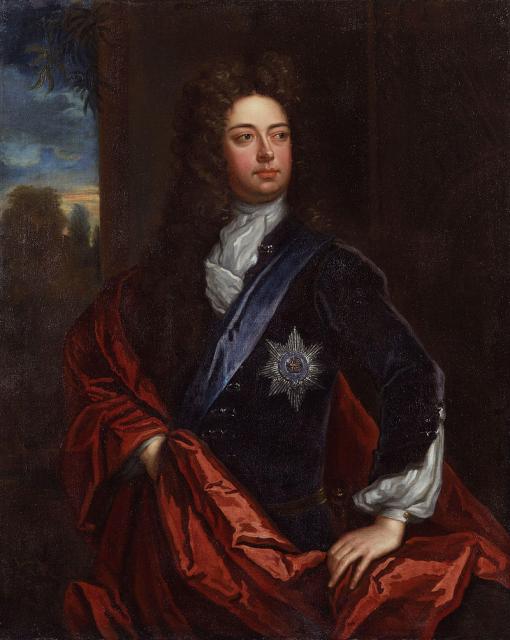
John Churchill
 Great Britain
Biography of John Churchill
John Churchill was an English military and political figure who distinguished himself during the War of the Spanish Succession. He is renowned as the most outstanding English commander in history. For his accomplishments, he was granted the titles of Earl and later, 1st Duke of Marlborough. In his youth, Churchill served as a page to the Duke of York (later King James II). He served in Flanders and then spent five years in French service. Upon his return in 1678, he married Sarah Jennings, a maid of honor to Princess (later Queen) Anne. This marriage, and his sister Arabella's connection to the Duke of York, greatly contributed to his success.

During the reign of James II, Churchill became a general and Baron Sandridge. He fought against the Monmouth Rebellion but fell out with the king and surrendered with his troops to William of Orange in 1688. In 1689, William made him the Earl of Marlborough. Marlborough fought in the Netherlands in 1689 and in Ireland in 1690. However, his involvement in Jacobite plots against William led to his dismissal and arrest in 1692. He was later reinstated in 1698 but only achieved significant success upon Queen Anne's ascension to the throne in 1702. She appointed him Commander-in-Chief of all English forces in the War of the Spanish Succession, while his close friend, Lord Treasurer Godolphin, oversaw internal affairs.
Over the next eight years, both Marlborough and Godolphin worked together with unprecedented success. The queen's favor, thanks to the influence of the Duchess of Marlborough, was on their side. Elevated to the rank of Duke, Marlborough, along with Prince Eugene of Savoy, defeated the French and Bavarians at the Battle of Blenheim (Höchstädt) on August 13, 1704. Marlborough's diplomatic skills also paved the way for the successful campaign of 1706, in which he crushed the French at the Battle of Ramillies. This period marked the height of Marlborough's glory.
The Marlborough-Godolphin administration faced increasing opposition due to Tory discontent with the war. Meanwhile, Harley, aided by the courtier Abigail Masham, started plotting against the powerful Duke and his wife with the queen. Marlborough achieved one last brilliant victory at the bloody Battle of Malplaquet in 1709. However, a crisis unfolded in England during his absence, leading to Godolphin's departure and the formation of a Tory ministry under Harley and Bolingbroke.
Although Marlborough retained command of the troops, he faced obstacles in all his endeavors. Despite his reluctance, a peace treaty was signed on October 8, 1711. He was then accused of financial mismanagement, stripped of his offices, and sent into exile in the Netherlands and Germany. He only returned to England after the death of Queen Anne in August 1714.
George I once again appointed him Commander-in-Chief, but he no longer held the same significance. Marlborough was tireless as both a military commander and diplomat. He was bold, determined, and cool-headed, but his passion for money somewhat tarnished his reputation. The title and estates of Marlborough passed to his grandson through his daughter, Charles Spencer, from whom Winston Churchill and Princess Diana are directly descended.