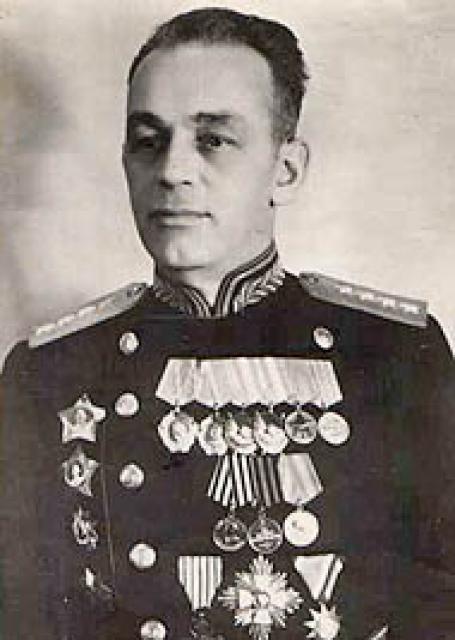
Vladimir Kurasov
- Early Life and Military Career
- Russian Civil War and Interwar Period
- Pre-World War II Service
- World War II
- Post-War Career
Early Life and Military Career
Vladimir Vasilyevich Kurasov was born in St. Petersburg, Russia, on August 28, 1895. The son of a working-class family, he completed eight grades of technical school before beginning work at an engraving workshop in 1913.
In September 1915, Kurasov joined the Russian Imperial Army as a volunteer. He served in the reserve battalion of the Leib Guard Semyonov Regiment. In 1916, he graduated from the Telavi Military School for Ensign and was sent to fight on the First World War's Eastern Front.
Russian Civil War and Interwar Period
From December 1915, Kurasov commanded a platoon in the 148th Infantry Regiment. In February 1916, he joined the Western Front as the commander of a trench warfare team in the 530th Infantry Regiment. After the February Revolution, his comrades unanimously voted for him to continue leading this unit.
In late 1917, Kurasov was in Petrograd and joined the Red Guard, forming a company and later a battalion. He actively participated in the October Revolution.
Kurasov joined the Red Army in December 1918. During the Russian Civil War, he served as an instructor and commander of various units, including a detachment of Baltic Fleet sailors. He played a significant role in the defense of Petrograd against the Northwestern Army and the suppression of the revolt at Fort Krasnaya Gorka.
Pre-World War II Service
After the Civil War, Kurasov continued his military education and service. He graduated from the Military Pedagogical Institute in 1921 and commanded a training company and taught tactics at various military schools. In 1932, he completed the M. V. Frunze Military Academy of the Red Army and served in the staff of the Belarusian Military District.
In 1935, Kurasov became the chief of staff of the 16th Rifle Corps. He attended the Academy of the General Staff of the Red Army from 1936 to 1938 and remained there as a senior lecturer on the tactics of higher formations. In 1940, he became head of a department and later deputy head of the Operational Directorate of the General Staff.
World War II
In the early months of World War II, Kurasov worked in the General Staff. In December 1941, he was appointed chief of staff of the 4th Shock Army on the North-Western and Kalinin Fronts. The army's advance during the Toropets-Kholm Operation in January-February 1942 covered nearly 300 kilometers, a significant achievement during the Battle of Moscow.
From March 1942, Kurasov commanded the 4th Shock Army, which was deployed in a relatively quiet sector of the Kalinin Front. In April 1943, he became the chief of staff of the Kalinin Front (renamed 1st Baltic Front in October 1943). He played a crucial role in planning and conducting the Smolensk, Nevel, and Gorodok Operations in 1943.
During the Belorussian Strategic Offensive Operation in 1944, Kurasov's forces conducted successful operations in the Vitebsk-Orsha and Polotsk regions. In the fall of 1944, he distinguished himself in the Baltic Operation, particularly on the Riga and Memel fronts.
From January 1945, the 1st Baltic Front participated in the East Prussian Strategic Offensive Operation and independently conducted an operation to eliminate the Memel enemy bridgehead and liberate the city of Memel (Klaipėda). In February 1945, the 1st Baltic Front was dissolved, and Kurasov became the chief of staff of the Zemland Group of Forces of the 3rd Belorussian Front. In April 1945, his forces conducted the Zemland Operation, defeating the enemy on the Zemland Peninsula and, in conjunction with the Baltic Fleet, landing a force on the Frische Nehrung spit.
Post-War Career
Shortly before the end of the war, Kurasov was appointed deputy chief of the General Staff. However, he served in this position for less than two months before being named chief of staff of the Soviet Military Administration in Germany in June 1945. He subsequently served as deputy commander-in-chief and, from April 1946, commander-in-chief of the Central Group of Forces in Austria and Supreme Commissioner in Austria from the USSR.
From April 1949, Kurasov became the head of the Higher Military Academy named after K. E. Voroshilov (later the Military Academy of the General Staff). In 1956, he was appointed deputy chief of the General Staff for scientific and military work. In December 1961, he was reappointed as the head of the Military Academy of the General Staff and became a professor in 1963. From March 1963, Kurasov served as the representative of the Commander-in-Chief of the Joint Armed Forces of the Warsaw Pact countries in the National People's Army of the German Democratic Republic.
In 1965, Kurasov was awarded the Hero of the Soviet Union for his leadership and bravery during the Great Patriotic War. From April 1968, he served as a military inspector-adviser in the Group of General Inspectors of the USSR Ministry of Defense.
Vladimir Vasilyevich Kurasov died on November 29, 1973, in Moscow. He was buried in the Novodevichy Cemetery.



