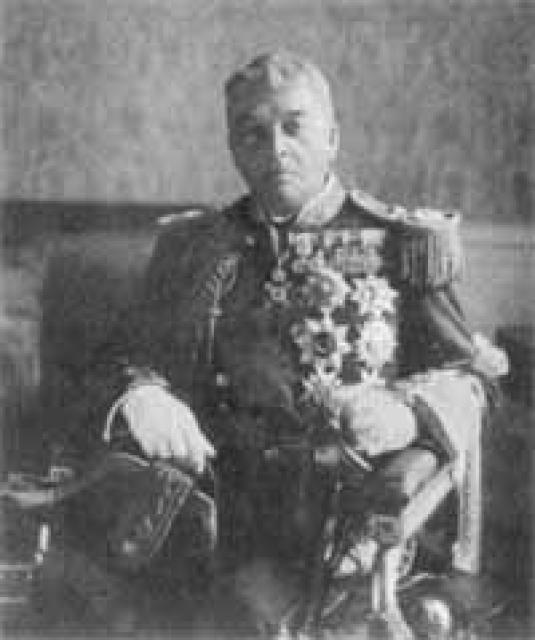
John Fisher
 Great Britain
- Early Life and Naval Career
- Artillery Specialization
- Command and Naval Reforms
- Dreadnought Era
- First World War
- Later Years
Early Life and Naval Career
Sir John Fisher was born into a planter's family in Ceylon (now Sri Lanka). In 1854, he entered the Royal Navy as a cadet. He served in the Crimean War (1853-56) and the Chinese Expedition (1856-60), distinguishing himself in the capture of the Taku Forts in 1859.
Artillery Specialization
After the Crimean War, Fisher focused on artillery and technology. In 1863, he became the artillery officer on the ironclad warship HMS Warrior. He dedicated himself to reforming the navy's artillery and organization.
Command and Naval Reforms
Fisher commanded the new battleship HMS Inflexible during the bombardment of Alexandria in 1882. As Admiral of the Fleet, he held various positions in the Admiralty, including Superintendent of Portsmouth Dockyard and Controller of the Navy.
In 1892, he became Third Lord of the Admiralty, introducing radical reforms that faced opposition from influential naval circles. A commission headed by Prime Minister Asquith exonerated Fisher of any wrongdoing.
Dreadnought Era
Fisher is best known for his role in creating the Dreadnought, a revolutionary battleship with ten 12-inch guns and steam turbines that could achieve speeds of up to 22 knots. The Dreadnought became the foundation of the British Royal Navy, making it the strongest in the world by 1909.
First World War
In 1914, Fisher was recalled to serve as First Sea Lord. He mobilized the Royal Navy and initiated a large-scale shipbuilding program. However, he resigned in 1915 due to disagreements over the Dardanelles Operation and conflicts with Winston Churchill.
Later Years
After his resignation, Fisher chaired the Board of Invention and Research. He also authored several memoirs. Fisher's legacy continues to influence naval strategy and technology today.


