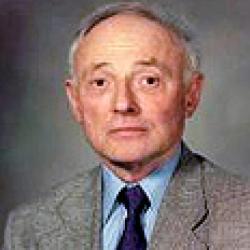
John Forbes Nash Jr
 USA
USA- Biography of John Forbes Nash Jr.
- Early Life
- Education and Career
- Struggles with Schizophrenia
- Recovery and Later Life
Biography of John Forbes Nash Jr.
John Forbes Nash Jr. was an American mathematician who achieved recognition in the field of game theory and differential geometry. In 1994, he was awarded the Nobel Memorial Prize in Economic Sciences, along with his colleagues Reinhard Selten and John Harsanyi, for their analysis of equilibrium in non-cooperative games. Nash gained widespread fame with the release of the biographical film "A Beautiful Mind," directed by Ron Howard, which depicted his mathematical genius and his struggle with paranoid schizophrenia.

Early Life
John Forbes Nash Jr. was born on June 13, 1928, in Bluefield, West Virginia, United States. He grew up in a strict Protestant family, with his mother working as a teacher before getting married, and his father working as an engineer. Nash did not excel in school and had little interest in mathematics, mainly because his teachers presented it in a dull manner. However, at the age of 14, he became fascinated with the book "Men of Mathematics" by Eric T. Bell. He independently studied and proved Fermat's little theorem, which awakened his mathematical genius.

Education and Career
After obtaining bachelor's and master's degrees from the Carnegie Institute of Technology in 1948, Nash attended Princeton University. It was at Princeton that he learned about game theory, which captivated his imagination. At the age of 20, he developed the foundations of a scientific method that had a significant impact on the development of the global economy. In 1949, he presented his dissertation on game theory, laying the groundwork for his future Nobel Prize in Economics. Between 1950 and 1953, Nash published four papers on game theory with non-zero sum games, introducing the concept of the "Nash equilibrium." This equilibrium represents a situation in which winners and losers use an ideal strategy, leading to a stable outcome.
In 1951, Nash began working at the Massachusetts Institute of Technology (MIT) in Cambridge, where he wrote a series of papers on real algebraic geometry and touched upon theories of Riemannian manifolds. However, his mathematical work attempted to justify Karl Marx's theory of surplus value, which led to his marginalization. Nash was shunned by his colleagues, and his girlfriend, Eleanor Stier, ended their relationship. Despite these setbacks, Nash continued to pursue his mathematical research.
Struggles with Schizophrenia
In 1957, Nash married his student, Alicia Lopez-Harrison de Lard. They soon had a son, but their joy was overshadowed by Nash's first symptoms of schizophrenia at the age of 30. Alicia, desperate to save her husband's career, hid the family's struggles. However, in 1959, Nash lost his job. He was forcibly admitted to a private psychiatric hospital, where he was diagnosed with paranoid schizophrenia and underwent psycho-pharmacological treatment.
After spending 50 days in the hospital, Nash left for Europe with the help of his lawyer. Alicia left their son with her mother and joined Nash in Europe. However, they faced difficulties finding refuge in other countries due to the constant monitoring of the US State Department and the American naval attaché. After the French police arrested and deported Nash back to the United States, his illness continued to progress. Nash would speak about himself in the third person, experience groundless fears, make phone calls to former colleagues, and engage in discussions about numerology and politics. In January 1961, after a difficult decision made by his loved ones, Nash was admitted to the hospital again, where he underwent a risky course of insulin shock therapy.
Recovery and Later Life
Following his treatment, Nash returned to Europe for the second time, but without Alicia. In 1962, Alicia divorced him, and their son later developed schizophrenia as well. Despite the challenges, Nash received support from his mathematician colleagues and found employment at a university while taking antipsychotic medication. His illness subsided temporarily, but it resurfaced when Nash became fearful that the medication would impair his thinking. Nevertheless, in the 1970s, Alicia, burdened by guilt, reunited with Nash, possibly saving him from homelessness. His students nicknamed him the "Phantom" for his habit of writing strange formulas on blackboards. Surprisingly, his illness began to recede in the 1980s. Nash continued to pursue his beloved mathematics, this time with a "rational" approach, and declared that sound thinking was not as closely tied to the cosmos as previously believed.
In 2001, John and Alicia remarried. Their story is a testament to the struggles and triumphs of John Forbes Nash Jr., a brilliant mathematician who overcame the challenges of mental illness and made lasting contributions to the field of game theory.