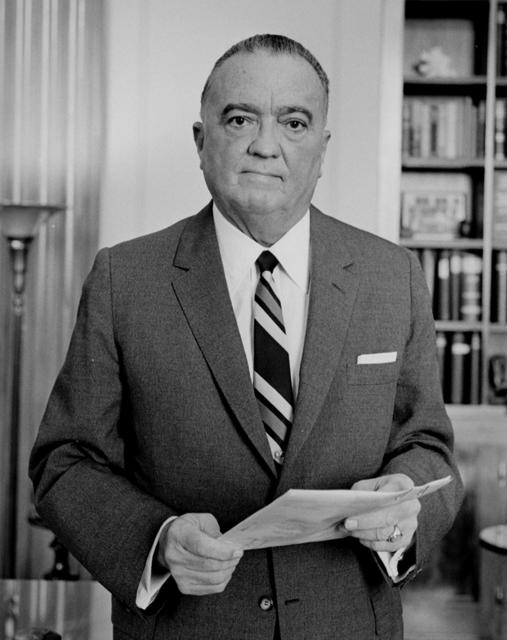
John Hoover
 USA
USA- Biography of John Hoover
- Early Life
- Career at the Department of Justice
- Controversial Actions and Legacy
Biography of John Hoover
John Hoover, also known as Edgar Hoover, was a director of the FBI, lawyer, and criminologist who served in his position for almost half a century. During his tenure, the country saw eight presidents come and go. With compromising information on influential politicians and connections to criminal organizations, Hoover's power was virtually unlimited. Even the Oval Office feared open confrontation with him. In the year when the Romanov dynasty fell in Russia and the United States entered World War I, a man started building his career who would become one of the most influential people in the USA. His name was Edgar Hoover. He transformed a small investigative agency into a globally renowned and powerful organization known as the Federal Bureau of Investigation (FBI). The main goal of the FBI is to combat political enemies of the state and investigate federal crimes.

Early Life
Edgar Hoover was born on January 1, 1895, to a family of the director of the United States Coast and Geodetic Survey. He had a brother and two sisters and was the third child of the Hoover family. During his school years, the future FBI chief showed himself to be a gifted child. His high grades delighted his mother. At the age of 11, Hoover started independently publishing a two-page newspaper called "Weekly Review," which he sold to his relatives and friends with the support of his mother for 1 cent each. He wrote all the articles in his newspaper without seeking help from adults. After finishing school, Hoover received a personal invitation to attend the University of Virginia, which was considered one of the best in America. However, due to his father's illness, he had to decline this tempting offer and enroll in the evening division of a local university. Because of financial difficulties in the family, Hoover had to pursue his education in the evening while working as a courier at the Library of Congress. His experience at the library greatly helped Hoover in his subsequent work.

Career at the Department of Justice
In 1917, after completing university, Hoover obtained a modest position at the Department of Justice. His responsibilities included tracking down individuals who evaded military service. Hoover diligently performed his work, often staying in his office until late at night. His hard work caught the attention of his superiors, and soon Hoover was promoted to the position of Chief of the Enemy Aliens Registration Unit. His career at the Department of Justice rapidly gained momentum. Within just one year, he was promoted three times, and his salary doubled. In the summer of 1919, Edgar Hoover became the head of the section combating dangerous foreigners. In two years of work in this section, Hoover created a file containing 450,000 names of potential enemies. As a result of his work, he was promoted once again, this time becoming a special assistant to the director. In this position, Hoover began his fight against the "red threat." The results were immediate, with 249 people being expelled from the United States. In January 1920, 10,000 "reds" were arrested, most of whom were not even communists. For such a "successful" fight against the hated communism, Hoover was appointed Deputy Director of the Bureau of Investigation. Just a year later, Attorney General Harlan Stone appointed the 29-year-old Hoover as the director of the organization. Hoover's activities as the director began with reforms. An entrance exam was introduced for candidates applying for jobs at the Bureau. Nepotism was prohibited. Incompetent employees and those associated with any political forces were laid off. A school for criminologists was opened, and a fingerprint database was created, which later became the largest in the world. Self-education was encouraged among the bureau's employees. Before Hoover's arrival, the Bureau of Investigation had very limited powers. For example, agents were prohibited from making arrests or using weapons, even in self-defense. These powers were granted to the Bureau only in 1934, largely thanks to Hoover. In 1935, FBI agents tracked down and killed the notorious bank robber and gangster John Dillinger during a gunfight. After this successful operation, the Bureau of Investigation acquired national status and was renamed the Federal Bureau of Investigation (FBI). The power and popularity of the FBI director grew rapidly. Two prestigious universities awarded Hoover a doctoral degree in law.
Controversial Actions and Legacy
In 1938, tragedy struck in the home of the FBI director. Hoover's mother, Anna Marie Hoover, to whom he was deeply attached, died of cancer. In 1940, President Franklin Roosevelt ordered Hoover to increase surveillance over his political opponents. Contrary to the law, Hoover ordered his agents to start wiretapping phone calls and intercepting the correspondence of people who caused inconvenience to the president. Hoover gained full control over all communication lines in the country. The day after the events at Pearl Harbor, FBI agents began arresting Japanese, Italian, and German immigrants living in the United States. Interestingly, the lists of people to be arrested had been compiled even before the Japanese attack on the harbor. A total of 3,846 "enemies" and "spies" were apprehended. In 1947, with the support of Senator Joseph McCarthy, who held the post of senator at that time, Hoover launched an unprecedented campaign against communists, which became known as the "witch hunt" or "McCarthyism." Artists sympathetic to communists disappeared from the screens, journalists lost their jobs, and films by "leftist" directors were not released. In just the year 1950, 151 film industry workers were arrested in Hollywood alone. Even the greatest actor of the 20th century, Charlie Chaplin, was not spared. He was simply banned from entering the country. As part of the "witch hunt," Hoover planned to arrest 12,000 people.
The time came when, by law, Hoover was supposed to retire. But he had no intention of doing so. In the spring of 1964, at a banquet celebrating his 40th anniversary of labor, President Lyndon B. Johnson declared that the law on retirement did not apply to the director of the FBI. Hoover had incriminating information on Johnson. The president had spent more money on his election campaign than allowed by law. Hoover remained the director of the FBI until his death at the age of 77 on May 2, 1972. According to Hoover's instructions, his deputy and close friend Clyde Tolson destroyed the archive containing compromising information that the FBI chief had collected for decades. Edgar Hoover was buried with presidential honors in Washington. Perhaps this was how the American political elite thanked the FBI director for not exposing his secret archive to the public.




