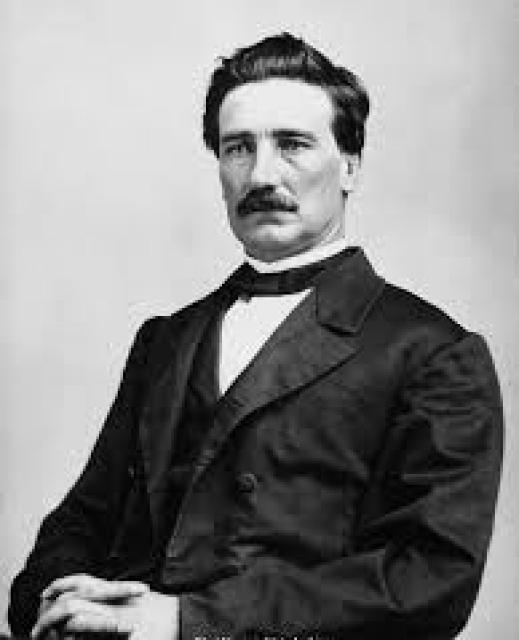
John Imboden
 USA
USA- John D. Imboden: From Civilian to Renowned Military Leader
- Early Life and Education
- Legal and Political Career
- Civil War Service: Artillery and Cavalry
- The Raid on Northwestern Virginia
- Gettysburg Campaign
- Retreat from Gettysburg: Protecting the Confederate Train
- Post-Gettysburg Service and Illness
- Post-War Career and Legacy
John D. Imboden: From Civilian to Renowned Military Leader
John Daniel Imboden, a lawyer by profession, emerged as a brilliant artilleryman and astute cavalry commander during the American Civil War, his accomplishments recognized by General Robert E. Lee himself.
Early Life and Education
Born in Staunton, Virginia, on January 16, 1823, Imboden had a typical upbringing for a well-to-do Southern boy. At age 16, he enrolled at Washington College in Lexington (now Washington and Lee University) to pursue a degree in law.
Legal and Political Career
Upon graduating, Imboden established a law practice in Staunton and was twice elected to the Virginia House of Delegates. However, the outbreak of the Civil War compelled him to leave politics for the battlefield.
Civil War Service: Artillery and Cavalry
Enlisting in a Staunton-based artillery unit, Imboden quickly rose to the rank of captain. He commanded an artillery battery at the capture of Harpers Ferry and distinguished himself at the First Battle of Manassas.
After leaving the artillery, Imboden raised a horse battalion, which he led during Stonewall Jackson's Shenandoah Valley campaign. His battalion played a critical role in the battles of Cross Keys and Port Republic.
The Raid on Northwestern Virginia
On January 28, 1863, Imboden was promoted to brigadier general and led a famous raid into northwestern Virginia with William "Grumble" Jones. They captured thousands of cattle and horses and disrupted essential Union transportation lines.
Gettysburg Campaign
Imboden's cavalry did not participate in the grand review at Brandy Station or the subsequent battle, but they marched northward with the Army of Northern Virginia. At Gettysburg, they guarded the Confederate rear at Chambersburg.
Retreat from Gettysburg: Protecting the Confederate Train
Imboden's finest hour came during the Confederate retreat from Gettysburg. He brilliantly defended the train of wounded, ammunition, and provisions from persistent Union cavalry attacks. On July 6, the flooding Potomac prevented Imboden and his forces, now including several artillery batteries, from crossing the river. Despite their precarious position, Imboden defeated the pursuing Union cavalry under Buford and Kilpatrick at Williamsport, saving the Confederate wagons and wounded. This victory was remarkable as it marked the first time Imboden had commanded troops on foot.
Post-Gettysburg Service and Illness
Imboden continued his cavalry service in the Shenandoah Valley as Jones's second-in-command. When Jones was killed at the Battle of Piedmont in June 1864, Imboden transferred under Lieutenant General Jubal Early's command. That fall, he fell ill with typhoid fever, which hindered his military effectiveness for the rest of the war. He surrendered as commandant of a military prison in South Carolina.
Post-War Career and Legacy
After the war, Imboden returned to Washington County, Virginia, and became involved in coal mining. He founded the coal town of Damascus, where he died on August 15, 1895. John D. Imboden, the "savior of the Confederate train and wounded," is buried in Hollywood Cemetery in Richmond.


