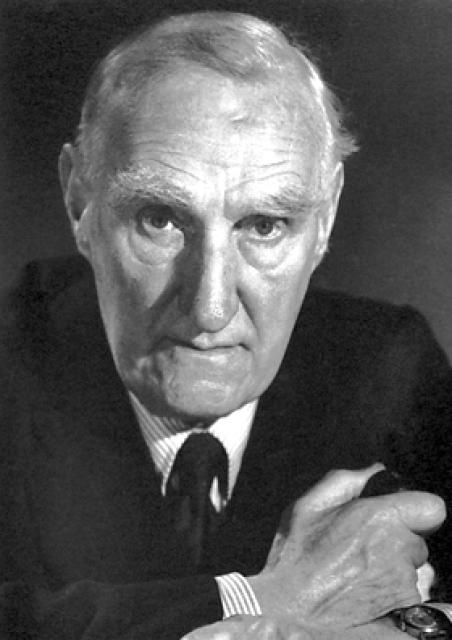
John Orr
 Great Britain
- Biography of John Boyd Orr
- Childhood and Education
- Military Service and Professional Achievements
- Contributions to Public Health and World Food Policies
Biography of John Boyd Orr
John Boyd Orr was an English educator, physician, and social activist, as well as the winner of the Nobel Peace Prize in 1949.
Childhood and Education
John Boyd Orr was born in 1880 in Scotland, the fourth of seven children to Robert Clark Orr, the owner of a small quarry, and Annie Boyd. He was raised in a strict and religious household. When he was five years old, his father's business faced financial difficulties and the Orr family moved to a more modest home in West Kilbride near Fertof-Clyde. Boyd received his elementary education at home, thanks to the teaching of his mother and his paternal grandmother. At the age of 13, he enrolled in a neighboring school but showed little interest in his studies and was eventually sent back home. He then worked for his father and attended a rural school, devoting much of his time to reading. At the age of 19, Boyd was awarded a royal scholarship and entered the University of Glasgow to study theology. However, his interest in science grew as he became acquainted with Darwin's theory, which had a profound impact on him. Gradually, Boyd drifted away from the church. He completed his studies at the university in 1902 and, as a requirement of his scholarship, taught in the slums of Glasgow and the Saltcoats Lowlands for four years. Deeply affected by the poverty, malnutrition, and diseases his students faced, Boyd returned to university to study medicine. In 1914, he graduated with honors and practiced medicine for a period of time. He then took an administrative position at the newly established Animal Nutrition Laboratory at the University of Aberdeen.
Military Service and Professional Achievements
Shortly after joining the laboratory, Boyd volunteered for military service during World War I. After 18 months in England, he became a medical officer in an infantry regiment that saw action in the battles of the Somme, Ypres, and Passchendaele. For his bravery, Boyd was awarded the Military Cross and the Order of the British Empire. Realizing that he could be of greater service in the navy, he requested a transfer and was involved in the development of nutritional requirements for military personnel.
After the war, Boyd returned to Aberdeen, where he completed the construction of the laboratory. Over the following years, he established the Rowett Research Institute for the study of nutrition, the Walter Reid laboratory, the experimental farm of John Dewar Webster, and the Stratcon House Nutrition Center, which attracted specialists from around the world. Boyd gained scientific reputation by researching the importance of protein and metabolism for animals. In 1925, during his survey in Africa, he compared the diets and lifestyles of the Maasai, who relied on meat, milk, and blood, with the Kikuyu, who primarily consumed maize. This research convinced Boyd that the institute's findings could be used to improve human health. He began his journey by studying the nutritional properties of cow's milk.
Contributions to Public Health and World Food Policies
Despite the significant development of the dairy industry in England, the nutritional value of milk, especially for children, was underestimated as farmers avoided overproduction to maintain prices. In Boyd's first study, he and his colleagues selected three groups of schoolchildren in Ireland and Scotland. The first group received half a pint of milk per day, the second group received a pint of skimmed milk, and the third group received biscuits with the same calorie content. Over the course of seven months, the children who received milk showed significant growth and improved health. Similar results were observed among families with children in the mining district of Lanarkshire. Based on this data, the British Parliament passed a law mandating the provision of cheap or free milk in state schools. Throughout the 1930s, Boyd continued his research and realized that the UK needed a targeted and scientifically grounded food policy, but he failed to gain government support. In 1936, his publication "Food, Health, and Income" sparked a lively debate, revealing that less than half of the English population could afford adequate food, and every tenth person suffered from malnutrition. As a member of the Food and Agricultural Organization (FAO) Technical Committee on Nutrition, Boyd helped develop a statement on dietary standards and planned what he called the "marriage of health and agriculture" on a global scale.
The international tensions of the late 1930s delayed the implementation of these plans. In 1938, the British government, concerned about the danger of war, asked Boyd to assess the food reserves in Nazi Germany. Upon his return, he reported on the satisfactory nutrition of German youth and their well-thought-out agricultural program. The increasing threat of war prompted Boyd to contemplate wartime food policies. In his book "Feeding the People in War Time," co-authored with David Lubbock and published in 1940, Boyd developed an inexpensive food system using domestic products that could sustain the nation. The book also proposed measures for rationing, price controls, and agricultural regulation, many of which were later implemented. In 1942, Boyd visited the United States at the invitation of the Milbank Memorial Fund and met with Vice President Henry Wallace to discuss global food policies. In 1943, President Franklin D. Roosevelt invited delegates from allied nations to Hot Springs, Virginia, to begin the development of the principles of the Atlantic Charter, one of which was "Freedom from Want." The British government did not include Boyd in the delegation, partly because he advocated international measures that could harm Britain's competitiveness in the global market.
When Boyd's term in the FAO expired in 1948, he continued to promote his ideas through articles and speeches. He called on technologically advanced countries to eliminate world hunger and advocated for a world government capable of ending wars. Boyd traveled extensively throughout Europe and visited India in 1949, where he advised the government on agricultural development and food distribution. He was awarded the Nobel Peace Prize in recognition of his efforts "not only to eliminate hunger but also to lay the foundations for peaceful cooperation among classes, nations, and races," as stated by Gunnar Jahn, the representative of the Norwegian Nobel Committee. In his Nobel lecture, "Science and Peace," Boyd discussed the possibility of "eliminating the causes of war and entering an era of global unity through new knowledge and harnessing the forces of nature provided by modern science." While advocating for "forms of world government with internationally agreed laws and means of enforcement," he acknowledged that "peace on earth can never be achieved when so many people lack the basic necessities and rely on political and economic system change. Peace on Earth must be built on universal abundance."
In the following years, Boyd remained engaged in international affairs. In 1951, he visited Pakistan, where he helped strengthen the distribution system. He later served as a member of the British delegation at the 1952 Economic Conference in Moscow and participated in scientific and economic contacts with Eastern European countries. Boyd also visited China in 1956 and Cuba in 1962. In 1971, at the age of 90, he passed away at his home near Brechin in Scotland.
Throughout his life, Boyd received numerous honorary titles from various European universities. In 1935, he was knighted, and in 1948, he became a peer. He was a member of the Royal Society, an honorary member of the American Public Health Association, and the New York Academy of Sciences. In 1945, Boyd was elected president of the World Association for World Federation. Among his other awards were the Garben Medal of the Royal Institute of Public Health, the Lasker Award from the American Public Health Association, and the French Legion of Honor.
Boyd's wife, Elizabeth Pearson Collum, whom he married in 1915, provided him with support throughout his life. They had two daughters and a son, who tragically died during World War II. Known for his work ethic, Boyd devoted six days a week to his endeavors. He was a tall and lean man with a gentle gaze from his blue eyes and possessed a remarkable ability to persuade others. In his leisure time, he enjoyed solitary walks in the hills of Scotland and Scottish folk dances.