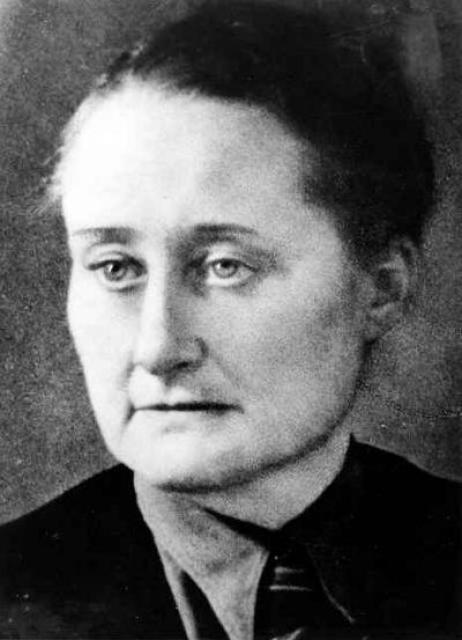
Elisabeth Von Thadden
 Germany
Biography of Elisabeth von Thadden
Elisabeth von Thadden was a German teacher and member of the German Resistance movement. Born on July 29, 1890, in Morungen, East Prussia, she came from a noble family. Her father, Adolf von Thadden-Trieglaff, served as an administrator in the Graifenberg district. Elisabeth was the eldest of five children and grew up in a Christian Protestant household.
In 1905, the family moved to the Triglaff estate in Pomerania. Elisabeth's brother, Reinhold von Thadden, became a renowned theologian and jurist, while her nephew, Rudolf, is now a well-known German historian. Elisabeth herself never married and did not have any direct descendants. After her mother's death, she took on the responsibility of managing the family estate and caring for her younger siblings.
The Triglaff estate was often used as a gathering place for political figures, theologians, lawyers, and scholars. Elisabeth felt a strong need to support her fellow citizens and during World War I, she allowed children from the city to spend time on the estate.
In 1920, Elisabeth's father remarried Barbara Blank. Following their marriage, Elisabeth moved to Berlin to pursue a career in education. She taught at various schools and eventually had the opportunity to lease the Schloss Wieblingen mansion near Heidelberg. In 1927, she established a private boarding school for girls, which included mandatory Christian ethics education based on her own upbringing and the ideas of educator Kurt Hahn.
As the Nazi party gained power, Elisabeth initially sympathized with some of their ideas but soon realized the fundamental contradictions between her compassion and the ideology being imposed. She became a fierce opponent of the regime. Despite official warnings, she continued to associate with her Jewish friends and accepted girls from Jewish families into her school, often reducing their tuition fees. Her outspoken views and her defiance of Nazi orders brought her under constant scrutiny by the Gestapo.
In October 1940, Elisabeth's school was evacuated to Tutzing, Bavaria, due to the growing conflict with the authorities. However, the Bavarian Ministry of Culture threatened to close the school, stating that it posed a threat to the state. In May 1941, Elisabeth moved the school to Wieblingen, hoping that its reputation and prominence would protect it from further persecution. Unfortunately, this was not the case. In May 1941, the Baden Ministry of Education accused the school of lacking Nazi ideology in its teachings, resulting in the school being confiscated and Elisabeth being removed from her position.
Returning to Berlin, Elisabeth joined the Red Cross as a nurse's assistant. During this time, she discovered that letters from German prisoners of war in the Soviet Union were being destroyed on Hitler's orders. She continued to establish connections with anti-Nazi individuals and organizations, such as the "Solf Circle," which aimed to provide support and aid to those in danger from the regime.
In September 1943, a guest at one of the "Solf Circle" meetings turned out to be an informant for the Gestapo, leading to the arrest of all its members, including Elisabeth. She was arrested on January 12, 1944, and subjected to months of interrogation and mistreatment in various prisons and the Ravensbrück concentration camp.
On July 1, 1944, the People's Court of the Third Reich sentenced Elisabeth to death for treason and undermining the morale of Nazi supporters. Her execution took place on September 8, 1944, in the Plötzensee Prison. Her last words were, "Lord, put an end to all our sufferings."
After the war, Elisabeth's remains were returned to her family for cremation. Her ashes were buried on the grounds of the school she founded, which was named in her honor. Today, the school continues to honor her legacy and maintain a strong connection to her educational philosophy.


