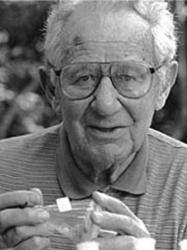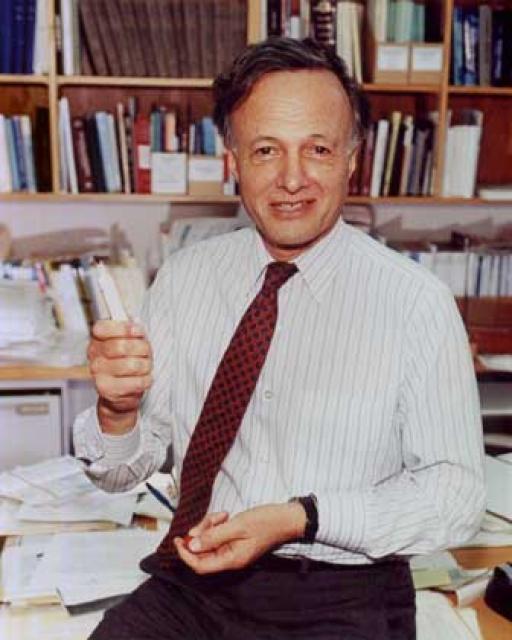
John Polanyi
 Canada
Biography of John Polanyi
John Polanyi is a Canadian chemist who was awarded the Nobel Prize in Chemistry in 1986. He was born into a Hungarian family to Michael and Magda Elizabeth Polanyi. When he was four years old, his family moved from Germany to Manchester, England, where his father became a professor of chemistry at the University of Manchester. Polanyi attended a school in Manchester and then enrolled at the University of Manchester in 1946. One of Polanyi's mentors was his father, who became his scientific supervisor. Polanyi conducted research on measuring the energy of chemical bonds using pyrolysis. In 1952, he obtained his doctorate in chemistry. However, during his student years in England, his main interests were in politics, journalism, and poetry.
After defending his doctoral dissertation, Polanyi worked at the laboratories of the National Research Council of Canada in Ottawa from 1952 to 1954. He also spent a few months in Gerhard Herzberg's laboratory, a Nobel laureate, where he assembled a spectroscopic setup to investigate vibrational and rotational excitations in iodine molecules. "Some invisible hand must have guided me," Polanyi later recalled about this period. Later on, he had the opportunity to measure the types of transitions he studied in Herzberg's laboratory in the reaction products.
From 1954 to 1956, Polanyi did his postdoctoral work at Princeton University in the United States. There, he became acquainted with experiments conducted by colleagues who were studying vibrational excitation in the reaction products of atomic hydrogen with ozone. This reaction exhibited orange luminescence when the reaction product spontaneously transitioned from highly excited vibrational states to a low excitation state. In 1956, Polanyi became a professor at the University of Toronto, and in 1962, he was promoted to full professor.
Polanyi conducted an experiment in which atomic hydrogen, produced by an electric discharge, was mixed with a stream of gaseous chlorine in a vessel equipped with windows made of sodium chloride, transparent in the infrared region. An infrared spectrometer was placed in front of a "window". The vessel in which the reaction occurred remained cold to the touch but emitted an infrared spectrum indicating the presence of hydrogen at temperatures of several thousand degrees. This excitation was found to be of a chemical nature and represented infrared chemiluminescence. In 1958, Polanyi and his student J. C. Kashion concluded that "this method provides information concerning the distribution of vibrational and possibly rotational energy among the products of a three-center reaction." The technological details of their research were described in the paper "Infrared Maser Based on Vibrational Excitation", written in 1960. The journal Physical Review Letters, to which Polanyi submitted this paper, declined to publish it. In September 1960, Polanyi submitted the paper to the Journal of Chemical Physics, and it was immediately published.
In 1968, using the chemiluminescence method proposed by Polanyi, it became possible to study the dynamics of chemical processes. One of the problems that hindered the research was rotational and vibrational "quenching". This problem was solved by spraying gaseous reactants that intersected in the center of a vacuum chamber, emitting infrared radiation accompanying the formation of reaction products. Despite its simplicity, infrared chemiluminescence provides complete, detailed, and accessible information about the energy distribution of chemical reaction products. This information is used to test theories of the molecular mechanism of simple exchange reactions. Polanyi's research group from the very beginning applied computer modeling. High-speed computers allowed them to solve complex equations of motion for reacting particles, and the connection of theory with practice enabled a deep understanding of the processes.
Infrared chemiluminescence is not limited to measuring the degree of excitation of reaction products; it can also be used to determine how vibrational and rotational excitation of different reactants affects the probability of reactions occurring. In 1986, Polanyi, along with D.R. Herschbach and Y.T. Lee, was awarded the Nobel Prize for his contribution to the development of research on the dynamics of elementary chemical processes.
As time went on, Polanyi expanded the scope of his scientific interests. He studied the spectroscopy of reaction transition states and also investigated the photochemistry of absorbed states, using ultraviolet laser radiation to induce reactions between neighboring molecules "attached" to a solid surface.
In the late 1950s, Polanyi came to the belief that scientists needed to participate in public life, especially in the age of nuclear weapons when the issue of survival was acute. In 1960, Polanyi founded and chaired the Canadian group of scientists affiliated with the Pugwash movement and remained its chairperson until 1978. Polanyi is an active member of the Committee on International Security Problems of the National Academy of Sciences of the United States and the Canadian Centre for Arms Control and Disarmament.
Polanyi actively participates in the work of the Royal Society, the Canadian Committee of Scientists for Freedom of Scientific Activity, and the Canadian Committee of Scientists. He finds time to participate in "Canadian Discussions on Science Policy Issues" and believes that only fundamental science can contribute to the future development of humanity. To those who criticize the impracticality of purely theoretical research, he responds: "There is nothing more impractical than science oriented only towards the needs of today."
Polanyi finds aesthetic pleasure in art, literature, and poetry. In his youth, he was passionate about canoeing and was a skilled amateur aviator. Currently, he prefers skiing and hiking.
Works by John Polanyi include "Some Concepts in the Dynamics of Chemical Reactions: Nobel Lectures" and "Dynamics of chemical reactions" published in the journal Disc. Faraday Soc. in 1967.