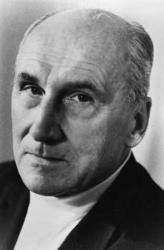
Tadeusz Reichstein
 Poland
Biography of Tadeus Reichstein
Tadeus Reichstein was a Swiss chemist and the laureate of the Nobel Prize in Physiology or Medicine in 1950. He was born in Wloclawek, Poland (then part of Russia) to Gustava (Brockman) and engineer Isidor Reichstein. He spent his early years in Kiev, where his father served. He attended a private educational institution in Jena, Germany. In 1905, the family moved to Berlin and later to Zurich, where Reichstein received private tutoring before enrolling in college and the Federal Polytechnic School.

In 1914, Reichstein and his parents obtained Swiss citizenship. Two years later, he passed his final exams at the Federal Polytechnic School and remained there as a chemistry teacher. After receiving his scientific degree in 1920, equivalent to a bachelor's degree, he worked as a chemical engineer for a year before returning to the Federal Polytechnic School to continue his studies in organic chemistry. In 1922, he obtained his Ph.D. in philosophy. In the same year, Reichstein and Hermann Staudinger began experimenting on the chemical composition of aromatic substances in coffee, a topic he also pursued for an industrial firm. He also conducted research on aromatic substances in chicory and published the results in scientific articles in the 1920s.
In 1929, Reichstein became a part-time professor of organic and physiological chemistry at the Federal Polytechnic School, where he completed his work on the aroma and taste of coffee and chicory in 1931. He was then appointed as an assistant to Leopold Ruzicka. In 1933, he synthesized vitamin C (ascorbic acid), approximately at the same time when English biochemists performed similar work. However, Reichstein's method is still used today for the industrial synthesis of vitamin C. In 1938, he became a professor of pharmaceutical chemistry and director of the Pharmaceutical Institute at the University of Basel in Switzerland. Around the same time, Reichstein conducted a series of experiments to isolate and identify adrenal hormones. Adrenal glands are paired endocrine organs located above the upper poles of the kidneys. They consist of cortical and medullary substances. The medullary substance synthesizes two hormones: adrenaline and noradrenaline. Adrenaline increases blood glucose levels, enhances heat production, and dilates blood vessels in skeletal muscles. Noradrenaline constricts blood vessels, leading to increased blood pressure. Cortical cells of the adrenal glands are under the control of a pituitary hormone called adrenocorticotropic hormone (ACTH). These cells synthesize corticosteroid hormones, the most important of which are cortisol, cortisone, and aldosterone. When cortisol levels are low (also known as hydrocortisone) in the blood, ACTH is secreted in the pituitary gland, which, in turn, stimulates the secretion of cortisol and hydrocortisone. When hydrocortisone levels are high in the blood, ACTH secretion decreases, leading to a decrease in cortisol and hydrocortisone levels.
Among the corticosteroids, glucocorticoids (cortisol and hydrocortisone) are involved in carbohydrate, fat, and protein metabolism, while mineralocorticoids regulate water-electrolyte balance. Cortisol and hydrocortisone also block certain immune system responses to injury or infection. The deficiency of adrenal cortex hormones can lead to Addison's disease (named after an English physician), characterized by anemia, weakness and fatigue, digestive disorders, changes in water-electrolyte balance, low blood pressure, and hyperpigmentation of the skin. In the 1920s, it was discovered that surgical removal of the adrenal glands in animals leads to a condition similar to Addison's disease in humans. It was also shown that extracts from the adrenal gland tissue can partially compensate for the changes caused by this disease or surgery. Since there are many precursors of adrenal hormones, their isolation and identification proved to be particularly challenging.
In the 1930s, Reichstein began studying adrenal cortex hormones and made two erroneous assumptions: firstly, he believed that there was only one such hormone, and secondly, that this hormone was not steroid. However, it soon became apparent that the adrenal cortex contains various steroid compounds, most of which are precursors in the biosynthesis process of biologically active corticosteroids. Later, Reichstein and his colleagues isolated and synthesized five of these substances. In 1935, they isolated aldosterone (although its chemical structure was not determined until 1952) and, over the next two years, nine other adrenocortical steroids, including corticosterone (substance E) and desoxycorticosterone (substance A). By 1942, scientists were able to obtain 27 different crystalline forms of corticosteroids. During this work, Reichstein also studied the relationship between the chemical structure of corticosteroids and their biological activity and found that activity was related to the biochemical characteristics of the first ring structure and side chain. In the late 1930s, George Thorn from Harvard Medical School successfully treated patients with Addison's disease using a combination of corticosterone and desoxycorticosterone. A few years later, Reichstein and his colleagues used a much simpler method to synthesize cortisol and hydrocortisone from the natural precursor, dihydroxycholic acid, which could be easily obtained from cat bile.
In 1943, Reichstein contributed to the classic textbook "The Hormones of the Adrenal Glands" and co-wrote the chapter "Vitamins and Hormones." In the same year, he obtained a patent for a method of synthesizing one of the sex hormones. Three years later, Reichstein and Ruzicka made a trip to the United States to give lectures at several research laboratories under the American-Swiss Society for Scientific Exchange. Reichstein was then appointed as the head of the Department of Organic Chemistry at the University of Basel, where he established the new Organic Chemistry Institute. Reichstein shared the Nobel Prize in Physiology or Medicine in 1950 with Philip S. Hench and Edward C. Kendall "for their discoveries relating to the hormones of the adrenal cortex, their structures, and their biological effects." In his Nobel lecture, Reichstein referred to himself as a "devoted gardener of African plants" that he grew for pleasure and professional purposes.
In his further research, Reichstein attempted to find inexpensive methods for obtaining corticosteroids by extracting and evaluating the biological properties of substances from certain African plants. He also studied plant substances that could affect heart function. In 1960, Reichstein was appointed as the director of the Organic Chemistry Institute at the University of Basel, and in 1967, he was awarded the Copernicus Medal.
In 1927, Reichstein married Louise Henriette Quarles, the daughter of a Dutch nobleman, and they had one daughter together.
Reichstein was awarded honorary doctorates from the University of Geneva, University of Zurich, University of Basel, and University of Leeds. In 1952, he became an honorary member of the Royal Society of London, and in 1968, he was awarded the Coplie Medal.