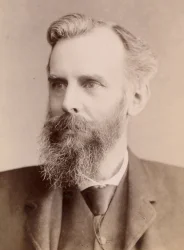
John Venn
John Venn (1834–1923) was an English logician, philosopher and university scholar whose name became familiar through the Venn diagram. At Cambridge, he helped make logic and probability part of a modern academic curriculum, while his historical research preserved the records of the university and its colleges. His work ranged well beyond the visual diagrams for which he is best known today.
Early Life and Education
Venn was born on August 4, 1834, in Drypool, near Hull. His father, Henry Venn, was an evangelical clergyman and prominent figure in the Church Missionary Society. John was educated first at home and at private schools, then entered Gonville and Caius College, Cambridge, in 1853. He graduated in mathematics in 1857, ranking sixth among the year’s wranglers, and was elected a fellow of the college.
After graduating, Venn was ordained as an Anglican priest and served in parishes in Surrey and Hertfordshire. He returned to Cambridge in 1862 as a lecturer in moral science. Over time, his intellectual outlook shifted away from the evangelical beliefs of his upbringing, though his life and work remained shaped by a deep interest in religion, ethics and philosophy.
Logic and Probability
Venn’s first major book, The Logic of Chance (1866), examined probability as a way to reason about real events and repeated observations. It was followed by Symbolic Logic (1881) and The Principles of Empirical or Inductive Logic (1889). These works reflected his view that logic should clarify how people draw conclusions from evidence and experience.
In an 1880 paper, Venn presented a systematic method of using overlapping closed curves to represent logical relationships among classes. The diagrams made it easier to see how categories intersect and differ. Earlier thinkers had used related visual methods, but Venn’s clear treatment and examples brought the technique wider recognition, and the diagrams eventually took his name.
Cambridge Scholar and Historian
Venn spent most of his professional life at Cambridge. He became president of Gonville and Caius College in 1903 and was elected a Fellow of the Royal Society in 1883. His contributions also included the development of the Moral Sciences Tripos, Cambridge’s course and examination in subjects such as philosophy, logic, political economy and law.
Later in life, he devoted increasing attention to the history of the university. He wrote a history of Gonville and Caius College and, with the assistance of his son John Archibald Venn, compiled Alumni Cantabrigienses, a large biographical register of Cambridge students, graduates and officeholders.
Legacy
Venn died in Cambridge on April 4, 1923, aged 88. The diagrams associated with his name remain widely used in logic, mathematics, statistics and education. Yet his lasting reputation also rests on his books about probability and inductive reasoning, his influence on Cambridge teaching, and his painstaking work documenting the university’s past.