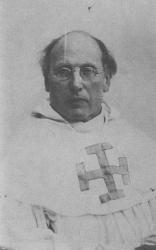
Jorg Liebenfels
 Austria
- From monastery scholar to racial theorist
- Ariosophy, Ostara and the New Templars
- The claimed Hitler connection
- Later years and legacy
Jörg Lanz von Liebenfels (born Adolf Joseph Lanz, July 19, 1874–April 22, 1954) was an Austrian racial ideologue, occult writer and founder of the Order of the New Templars. He promoted a conspiracy-minded racial mysticism that combined antisemitism, eugenics, esoteric speculation and selective uses of Christian imagery. Later he presented himself as a direct precursor of Adolf Hitler, but the extent of any personal influence remains disputed and no reliable evidence confirms their alleged meeting.
From monastery scholar to racial theorist
Lanz was born in Vienna, the son of a schoolteacher. After finishing school, he entered the Cistercian monastery at Heiligenkreuz in 1893, taking the religious name Georg. During his years there he wrote historical and art-historical studies and became fascinated by medieval orders, occultism and the Templar legend. He was ordained a priest in 1898, but left the monastery in 1899.
After leaving the church, Lanz increasingly embraced the völkisch nationalism and racial theories circulating in Central Europe. He began using the name Jörg Lanz von Liebenfels and presented himself as a baron and a doctor, claims not supported by biographical reference works. His writings drew on the racist theorist Guido von List, contemporary pseudo-science and his own eccentric reinterpretations of biblical and ancient texts.
Ariosophy, Ostara and the New Templars
In 1905, Lanz published Theozoology, a work that imagined humanity as the result of a primordial struggle between a supposedly divine “Aryan” race and inferior beings. Its claims were not science; they served as a mystical justification for racial hierarchy, antisemitism and eugenic control. Lanz argued for racial separation and “purity,” and his politics were also deeply misogynistic and hostile to social equality.
That same year he began publishing Ostara, a magazine that spread his racial and occult ideas. In 1900, he had founded the Order of the New Templars (Ordo Novi Templi), a small secret brotherhood modeled on medieval religious orders. In 1907 he acquired the ruins of Werfenstein Castle in Austria as the order’s center and raised a swastika flag there. The group remained marginal, but its rituals and publications formed part of a wider current of racist occultism in Austria and Germany.
The claimed Hitler connection
Lanz later claimed that Hitler had visited him in Vienna and read Ostara, and he sought recognition as one of the Nazi leader’s ideological teachers. Ostara circulated in Vienna while Hitler lived there, but historians have found no reliable evidence confirming the alleged meeting or a direct relationship between the two men. Similarities between Lanz’s racial nationalism and later Nazi ideology place him within the era’s extremist milieu; they do not establish that he personally supplied Hitler with his ideas.
After the Nazi annexation of Austria in 1938, Lanz hoped to gain favor from the regime. Instead, Hitler banned him from publishing and the magazine’s copies were removed from circulation. This rejection exposed the gap between Lanz’s self-image as a founding authority and his actual standing within the Nazi state.
Later years and legacy
Lanz continued writing esoteric and racial material, including multivolume works on what he called Ariosophy. He died in Vienna in 1954, aged 79. His lasting significance is not as the proven “father” of National Socialism, but as an example of the fringe racial mysticism and antisemitic politics that circulated in Austria before the Nazi era. His writings helped popularize a vocabulary of racial purity and occult hierarchy, while the strongest claims about his direct influence on Hitler remain unsubstantiated.