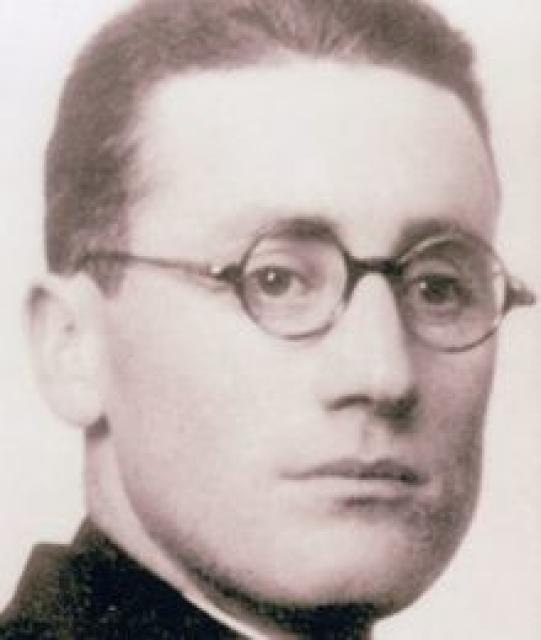
Jose Maria Arizmendiarrieta
 Spain
Spain- Early Life and Vocation
- Spanish Civil War and Imprisonment
- Arrival in Mondragón and Founding of the Polytechnic School
- Establishment of Cooperatives and Financial Institutions
- Legacy and Impact
Early Life and Vocation
José María Arizmendiarrieta (often shortened to Arizmendi), a Catholic priest, was born in Barinaga, Markina, Biscay, Spain, as the eldest son of a humble family. At the age of 12, he entered the seminary.
Spanish Civil War and Imprisonment
During the Spanish Civil War, Arizmendi supported the Republicans against Francisco Franco, while other Basques (nationalists) fought for the Nationalist government. Having lost an eye in an accident, he could not serve as a soldier. Instead, he worked as a journalist for Basque-language newspapers. After the war, he was arrested for this and sentenced to death. According to legend, only an administrative oversight saved him from execution.
Released from prison, Arizmendi resumed his studies in Vitoria and was ordained a priest. Despite his desire to continue his studies in Belgium, he was appointed to a parish 50 kilometers from his hometown.
Arrival in Mondragón and Founding of the Polytechnic School
In February 1941, at the age of 26, Arizmendi arrived in Mondragón. The town was suffering the aftermath of the civil war, with high unemployment. The local priest had been killed by Franco's forces.
Arizmendi initially failed to impress his new parishioners. His one-eyed appearance and poor reading skills led some to petition the bishop for his replacement. However, his determination to help his flock led him to realize that economic development was key to solving the town's problems.
Inspired by the Basque tradition of cooperatives, Arizmendi founded a polytechnic school (now the Mondragon University) in 1943. The democratically run school was open to all young people in the region. He taught extensively at the school, which played a crucial role in training and empowering the townspeople.
Establishment of Cooperatives and Financial Institutions
In 1956, Arizmendi and several graduates of the school founded the first cooperative enterprise, Ulgor. This cooperative later expanded and diversified, becoming Fagor and the Mondragon Cooperative Corporation. In 1959, they created Caja Laboral (The Workers' Savings Bank), a credit union that provided financial services to cooperative members and initial funding for new cooperative ventures.
Legacy and Impact
The Mondragon Cooperative Corporation is now the seventh-largest corporation in Spain. Arizmendi, who died in Mondragón in 1976, is revered in his hometown and among cooperative movement activists worldwide for demonstrating the effectiveness and transformative power of cooperatives in local communities.
Arizmendi believed that "co-cooperativism is not about doing the opposite of capitalism, as if that system had no useful functions (...). Co-cooperativism must overcome it, and in order to do that, must assume its methods and dynamism."


