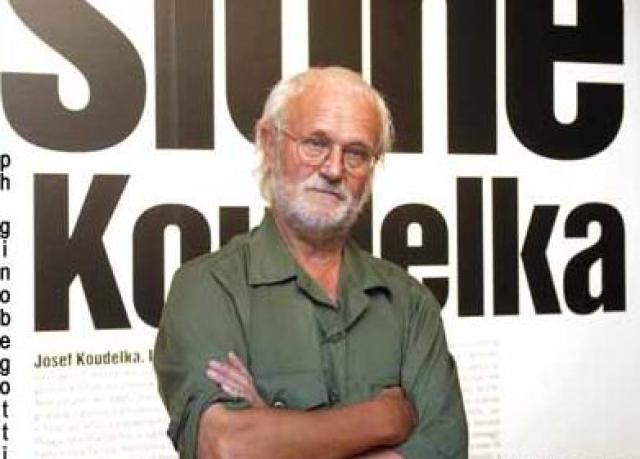
Josef Koudelka
 Czech
CzechBiography of Josef Koudelka
Josef Koudelka was born in 1938 in Boskovice, Moravia. From a young age, he developed a passion for photography, taking his first pictures with a 6x6 Bakelite camera. He later studied at the Czech Technical University in Prague, although his specialization was not photography. In 1961, Koudelka graduated as an engineer and began working in the aviation industry in Prague and Bratislava.
During his free time, Koudelka continued to pursue his passion for photography. It was during this period that he started capturing images at the Theatre Behind the Gate in Prague. He also began photographing Roma people, and his pictures of them quickly became the most colorful and captivating. Initially, he focused on Slovak Roma, but in 1968, he embarked on an interesting project in Romania and other European countries. In 1967, the Roma became the subject of his first exhibition.
The Roma, their way of life, characters, and overall vibrancy, have always been an intriguing and valuable subject for artists. Prior to Koudelka, renowned photographers such as Henri Cartier-Bresson, Andre Kertesz, and Robert Frank had also captured the Roma in their works. Additionally, the Roma became a beloved theme for the iconic filmmaker Emir Kusturica. Koudelka admitted that once he began working on the "Roma" theme, he simply couldn't stop. By the late 1960s, he had made the definitive decision to leave his engineering career behind and become a professional photographer.
Koudelka's "Roma" photographs are free from social issues, political aspects, or protests. They embody art in its purest form. However, in the summer of 1968, upon his return to Czechoslovakia after traveling throughout Europe, Koudelka witnessed dramatic political events. He photographed Soviet tanks on the streets of Prague, and his passion for capturing these moments made him oblivious to the danger. Those who saw him with a camera during those intense hours called him a "madman," a "maniac," and "possessed." He climbed onto tanks, photographing everything, and later admitted that he had simply forgotten to fear.
Koudelka's photographs were smuggled to "The Sunday Times" under the pseudonym P. P., Prague Photographer. At that time, he could not reveal his true identity, fearing reprisal. Interestingly, he was already recognized as a photographer in the prestigious agency "Magnum Photos." In 1969, the anonymous Czech photographer was awarded the Robert Capa Gold Medal.
A year later, Koudelka obtained a work visa in the United Kingdom, where he sought political asylum. It took him 16 years to publicly acknowledge his authorship, which brought renewed global recognition to his photographs from the late 1960s. In the 1980s, Koudelka relocated to France, where he continued his photographic work.
He was able to return to his homeland of Czechoslovakia for the first time since his escape in 1991. Koudelka's works have received numerous awards and honors, including the French Prix Nadar (1978) and Grand Prix Henri Cartier-Bresson (1991), the British Arts Council Grant (1976), the American Cornell Capa Infinity Award (2004), the Swedish Erna and Victor Hasselblad Foundation Photography Prize, and the Czechoslovak Award by Union of Czechoslovakian Artists.
Koudelka's photographs have been exhibited worldwide, including at the Museum of Modern Art and the International Center of Photography in New York, the Hayward Gallery in London, the Stedelijk Museum of Modern Art in Amsterdam, and the Palais de Tokyo gallery in Paris.
Today, Josef Koudelka continues to work and travel extensively, disproving his own statement that every photographer exhausts themselves by the age of forty. He splits his time between Prague and Paris and is known to have two daughters and a son.