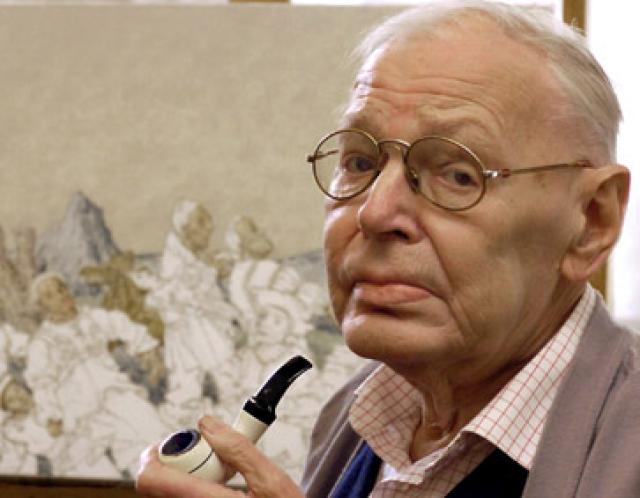
Werner Tubke
 Germany
Biography of Werner Tübke
IntroductionWerner Tübke was a German artist and one of the greatest painters of the German Democratic Republic (GDR). Alongside Bernhard Heisig, Wolfgang Mattheuer, and Willi Sitte, Tübke was considered one of the most talented painters in East Germany.
Early Life and Education
In 1946-1947, Tübke attended a vocational school in Magdeburg. He continued his studies at the Leipzig Academy of Graphic Arts and Book Art from 1948 to 1950, and later studied painting and psychology at the University of Greifswald.
Career
In 1952, Tübke became a staff member at the Central House of Amateur Arts in Leipzig. He became a member of the Association of Visual Artists of the GDR (VBK) in 1954. In 1955, he worked as an assistant at the Leipzig Academy of Graphic Arts and Book Art, but was dismissed in 1956. From 1958, Tübke focused on his work within the Association of Visual Artists. He held various positions, including member of the revision commission, working commission, and district chairman. In 1962, he returned to work at the Leipzig Academy of Graphic Arts and Book Art, and in 1964, he became an associate professor. In 1972, he was appointed as a professor and in 1974, he became the rector of the academy. In 1988, Tübke was elected as the vice-president of the Association of Visual Artists of the GDR.
International Recognition
Tübke gained international recognition in the 1980s. In 1982, he became a member of the Royal Swedish Academy of Fine Arts. In 1984, he was appointed as a professor at the International Summer Academy in Salzburg, and in 1988, he became an honorary member of the Academy of Arts of the USSR. His works were featured in the Biennale in Venice in 1984.
Artistic Style
Tübke's paintings resemble the style and inner content of old German painting. The events depicted in his works take place in the world of the Middle Ages and carry the signs of an impending apocalyptic catastrophe that is meant to destroy this world. His works sparked intense debates, particularly in West Germany. Some art critics condemned him as a renegade of modernity, seeking to escape from contemporary problems into the past. Others admired his beautiful works, considering Tübke as one of the most talented artists of Postmodernism. Tübke himself always refrained from commenting on his artworks.




