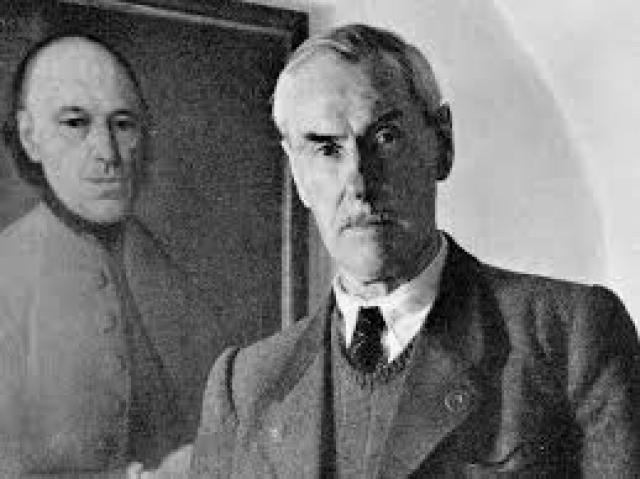
Joseph Wackerle
 Germany
- Josef Wackerle: German Sculptor of the 20th Century
- Artistic Career
- Collaboration with the Nazi Regime
- Sculptures for the Nazi Elite
- Legacy
Josef Wackerle: German Sculptor of the 20th Century
Early Life and EducationJosef Wackerle was born in a family steeped in artistic tradition: his grandfather was a woodcarver, and his father was an architect. At the age of 13, Josef began his artistic education at the Wood Sculpture School in his hometown. He later studied at the Munich School of Applied Arts and the Munich Academy of Fine Arts.
Artistic Career
In 1906, Wackerle became the artistic director at the Nymphenburg Porcelain Factory in Munich. From 1913 to 1917, he taught at the school of the Museum of Applied Arts in Berlin, and from 1917 onwards at the Munich School of Applied Arts. From 1924 to 1950, Wackerle held a professorship at the Munich Academy of Fine Arts.
Collaboration with the Nazi Regime
Wackerle was one of the most highly regarded sculptors during the Nazi era and became a Reich Culture Senator (Reichskultursenator). In 1937, Reich Minister of Propaganda Joseph Goebbels nominated Wackerle for the German National Prize for Science and Art. In 1940, on his 60th birthday, he received the Goethe Medal for Art and Science from Adolf Hitler himself. In August 1944, Hitler included Wackerle on the "Gottbegnadeten-Liste" (List of God-Blessed) of German artists and scientists who were exempted from military service. However, it is noteworthy that Wackerle was never a member of the Nazi Party and did not participate in its political activities.
Sculptures for the Nazi Elite
Wackerle became renowned for his sculptures commissioned for fountains and wells, including those for high-ranking Nazi officials. In 1938, he created a sculptural fountain for Martin Bormann's Munich home, and in 1939, he designed a relief depicting a young Pan and a nymph for Hitler's teahouse on the Obersalzberg. Wackerle's sculptures featuring nude figures adorned Hitler's residence in Berlin and the Reich Chancellery building.
Legacy
Josef Wackerle's work is a complex reflection of the artistic and political currents of his time. While his sculptures were celebrated by the Nazi regime, they also demonstrate his skill and talent as an artist. His sculptures remain part of the artistic landscape of Germany, but they also serve as a reminder of the dark period in German history during which they were created.



