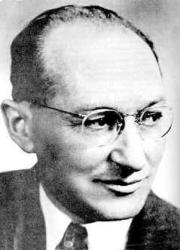
Joy Pol Guilford
 USA
USABiography of Joy Paul Guilford
Joy Paul Guilford (March 7, 1897 - 1976) was an American psychologist known for his research in the field of creativity. He received his education at the University of Nebraska, where he obtained his Bachelor of Arts degree in 1922 and his Master's degree in 1924. He then went on to earn his Ph.D. from Cornell University in 1927. Later, he obtained a law degree from the University of Nebraska in 1952 and a doctorate in sociology from the University of Southern California in 1962.
Early Career
Guilford began his academic career as an assistant professor at the University of Nebraska from 1920 to 1924. He then moved on to work at Cornell University from 1924 to 1926. In 1926, he became a psychology professor at the University of Illinois, and from 1927 to 1928, he served as an assistant professor of psychology at the University of Kansas. Guilford returned to the University of Nebraska in 1928, where he worked as an associate professor and later became the director of the Department of Educational Research from 1938 to 1940. In 1940, he joined the University of Southern California as a professor of psychology, a position he held until his retirement in 1967.
Research and Contributions
Guilford's early research focused on developing a questionnaire to distinguish between extraverts and introverts. However, he gained worldwide recognition for his studies on creativity, in which he attempted to mathematically model the creative personality using tests and factor analysis. This model was widely used in the assessment of creative abilities in American science and industry.
Through twenty years of research, Guilford developed the "cubical model of the structure of intelligence." This model consisted of three dimensions: operations (cognition, memory, evaluation, divergent and convergent productivity), content (visual, symbolic, semantic, and behavioral), and products (elements, classes, relations, systems, transformations, and implications). He and his colleagues were able to identify and provide diagnostic tools for 98 out of the 120 possible factors formed by the cells of this cube.
Guilford's research also focused on the study of divergent thinking, which involves solving problems with no fixed algorithm and allowing for multiple solutions. His work in this area led to the creation of the "University of Southern California Test," which assessed characteristics of divergent thinking such as fluency, flexibility, and originality.
Furthermore, Guilford believed that personality is a combination of specific individual traits, and he developed the "Survey of Interests" test to assess various temperaments including general activity, self-control, dominance, sociability, emotional stability, objectivity, friendliness, thoughtfulness, personal relations, and masculinity.
Additionally, Guilford conducted factor-analytic research on personality, identifying motivational factors such as organismic needs (hunger, sex, movement), environmental parameters (comfort, cleanliness), work-related needs (ambition, perseverance), social status-related needs (freedom, fairness), social needs, and general interests (risk-taking, leisure).
Legacy
Joy Paul Guilford made significant contributions to the field of psychology, particularly in the areas of creativity, intelligence, and personality. His research and models continue to influence the study of human behavior and cognition.