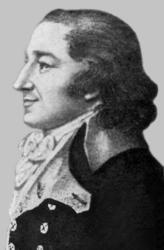
Justus Liebig
 Germany
Biography of Justus Liebig
Justus Liebig, a German chemist and one of the creators of the radical theory, was born on May 12, 1803 in Darmstadt. His father, the owner of a pharmacy, had a small primitive workshop (or rather, laboratory) outside the city to manufacture some of his products, so young Liebig became familiar with chemistry at an early age. The gymnasium, which focused on the study of humanities, did not correspond to Liebig's interests and abilities. Ancient languages, literature, and history dominated here, and the natural, or "real", disciplines were only lightly touched upon.
In those days, the path to studying chemistry still went through apprenticeship at a pharmacy, and Liebig was no exception in this regard. In the autumn of 1820, his secret desire came true: to study chemistry at the university in Bonn. Two years later, while at the University of Erlangen, Liebig was awarded a scholarship that allowed him to continue his education in Paris.
Later, Liebig recalled: "I learned, or rather, became aware, that there is a systematic dependence not only between two or three, but between all chemical phenomena in the realm of minerals, plants, and animals. No phenomenon stands alone, but is always connected to another, and the latter to a third, and so on with all other phenomena of nature. The emergence and cessation of things represent a kind of wave-like movement in the cycle of events." Liebig published his first work, dedicated to the connection between inorganic chemistry and plant chemistry, when he was a twenty-year-old student in Paris. For this work, the University of Erlangen awarded him a doctoral degree.
Liebig is the founder of a scientific school and one of the creators of agrochemistry. He was a foreign corresponding member of the St. Petersburg Academy of Sciences (1830). He discovered isomerism (1823) and obtained a series of organic compounds. He was one of the creators of the radical theory. Liebig is also the author of the chemical theory of fermentation and putrefaction, as well as the theory of mineral nutrition of plants.